Eight Strategies for Community Collaboration

partnersCommunities employ varied strategies and tactics to create positive change. These  strategies are a starting point for communities seeking ways to collaborate and improve their tourism products and experiences.

  1. 1.    Assess what’s working and what is not – This usually requires a consultant who can serve as an objective observer. Analysis of the visitor experience is best done by a planning professional who understands both the “front of the house experience” and “back of the house” logistics. He or she can help you see what you may overlook due to familiarity. Guest comments, Tripadvisor.com and other feedback are also helpful.
  1. 2.    Plan together with community input – A Community Experience Plan with stakeholders from varied sectors brings common goals and objectives to the table. Creating a logic model can be very helpful because it provides measurable objectives that can be used by all in planning and evaluation of progress to get results.
  1. 3.    Train together with consistent themes – Training front-line workers as guides and hosts will improve the visitor experience while encouraging community relationships. People from varied businesses and nonprofits learn together and can carry that relationship into future work. Through the training they will learn the themes and storylines developed through collaborative planning and understand how their role supports that effort.
  1. 4.    Package together to create rich experiences – Great visitor experiences that engage people in the community may require collaboration among lodging, food, transportation and recreation providers. Special events can also help diverse organizations achieve objectives in common.  The planning process will suggest these opportunities but then stakeholders have to continue to meet and agree to collaborate.
  1. 5.    Promote together with consistent themes – Promotions, tours, exhibits, informational publications and websites should be delivering shared themes and storylines. A community brand or identity is stronger with a commitment to consistency that requires collaborative efforts.
  1. 6.    Visit innovative communities and learn from them – Who do you admire as examples of great community experiences and brand identity? Travel together with a group of stakeholders to get a “cook’s tour” of those communities. Learn from them about how to make progress and adapt it to your situation.
  1. 7.    Use social media to monitor and promote the community –  TripAdvisor.com, Yelp.com, Facebook and other social media provide an opportunity to continually evaluate the public’s responses to your offers. They can also be used as a place to do surveys, hold conversations and collect information about customer views. These can also be ways to promote your experiences and encourage feedback.
  1. 8.    Meet regularly in standing committees that leverage funds – Monthly meetings of strategic partners can leverage grant funds and encourage monitoring of social media and measurable outcomes and impacts. Meeting over breakfast once a month is a great way to get people involved without breaking into their workday when competition for time is fierce.

Not everyone in a community will choose to work collaboratively but those that will can work together to create great experiences for residents and tourists. Usually someone has to provide leadership and invite others to the table. Collaborative work is addictive when done well with all partners benefiting personally and organizationally.

– Tim Merriman
Tourism Collaboration Should Be Easier – 5 Reasons To Collaborate

Remember when we were children? Our mothers worried about how to get us to play well together, to share toys and to cooperate. There seems to be some natural inclination among humans to compete. But even as children we found ways to overcome the tendency and collaborate. We built sand castles on the beach together, snow forts in winter and leaf forts in the fall. We played team sports and joined Cub Scouts and Girl Scouts who emphasize working together.

A Civic Tourism Conference in Rhode Island took participants to area attractions to better understand their role in the community experience.
A Civic Tourism Conference in Rhode Island took participants to area attractions to better understand their roles in the community experience.

So why is it so hard as adults to do this? There are great buzzwords for the dysfunction we often see and experience. “Silo Syndrome” or “Stovepipe Syndrome” describes a tendency to communicate up and down the organization or department but not outside of it. Some corporations and businesses have it internally and certainly we see it in large government agencies and communities. Individuals or organizations may belong to collaborative groups like the Chamber of Commerce or Convention & Visitors Bureau, but when it’s really time to do things together, they become guarded and proprietary. They often don’t show up at the meeting places and opportunities provided for collaborative thinking.

And yet there are many great reasons to collaborate internally and externally in communities, parks, zoos, agencies and organizations. Here are just a few to think about:

  1. The public sees our communities and organizations holistically. If one volunteer, partner or neighbor offends or mistreats a tourist or client, they might all get the blame. People don’t often notice when they cross boundaries or see a new type of nametag. They just know they are in Yellowstone or Sedona and organizational lines are blurred. Meeting regularly with logical partners and collaborators will help create new and expanded opportunities for guests/tourists with positive benefits for everyone. Training together helps to build a stronger sense of community among organizations that makes it easier to meet and discuss the potential for collaboration.
  2. Tourists seek interesting, quality experiences and usually that includes attractions like parks, zoos and museums, food providers, lodging and specialized transportation. When those are thoughtfully packaged and planning is collaborative, the experiences are better, more memorable and likely to make a lasting connection with the guest.
  3. Most organizations have a brand or image with a message that must be consistently delivered to connect and resonate with guests. If marketing folks, interpretive guides and public relation specialists are not working in concert, they step on each other’s messages and create dissonance for guests. Planning those messages, strategies and tactics should include the varied communicators working collaboratively.
  4. Partners can share costs as well as benefits. Whether buying transportation systems, advertising, market research or training, it is all less expensive with more partners paying the total cost. When partners invest in plans together, they are more likely to support the common vision for success that is developed. When partners/collaborators apply for grants together, the funder pays more attention.
  5. Collaboration builds a sense of community. Meeting regularly with partners and other stakeholders builds stronger personal relationships that make compromise and collaboration work. Staying in “silos” talking to those of a like mind may be easier, but it keeps an organization and individual from learning and growing. It also makes it harder to dismiss others as being wrong or misguided when there is a shared understanding of motives and the desire to collaborate.

41eulYJlfoL._AA160_Collaboration should be easier, but it requires commitment, planning and thoughtful communication. We wrote about Greensburg, Kansas, in our book, Put the HEART Back In Your Community, to share their amazing story of collaboration. In 2007 the small city in the plains was smashed by a tornado and through collaborative strategic planning, they grew back greener than their name. They proudly state they are an “authentic sustainable community.”

Many communities and organizations know they work in “silos,” but may find it difficult to employ the tools needed to collaborate. We recognize that it may not always be easy, but it’s well worth the effort. We’ll be sharing some recommended tools in future blogs. Maybe some will work for you.

– Tim Merriman

The Ethics of Interpretation – Choosing to make a difference

There are 33 elephants a day poached in Tanzania, a chilling indication of the threat to the survival of elephants.

A friend and colleague in Panama recently posted a question that caused me to think more deeply about a conservation issue. It seems a private zoo owner had attempted to move about ten percent of the remaining animals of a rare and endangered species from their natural habitat in Panama to his zoo collection in Dallas, Texas. Local people refused to allow the exportation of the animals, thereby thwarting his plans. Will that be the end of the story? Maybe, but maybe not. Until my friend advised me of the situation, I had no idea this was happening.

Another friend just posted an article from the Sudan that explained that President Obama has been asked repeatedly to take action to help the people in the Nuba Mountains who have been under attack for years, forced to live in caves or attempt to leave the region and go somewhere safe, if they can find such a place in this ravaged area of Africa. Although some people understand what’s happening, most in the United States would not be able to find Sudan on a map, much less know about the daily peril in which these people find themselves. Until someone made me aware of it, I had no idea this was happening.

I’ve had the pleasure of traveling on and leading photographic safaris several times in East Africa, yet few of my guides there have chosen to share the horrific truth about poaching and the very real danger of losing Africa’s elephants within the next decade. This is a story not just about elephants but about what happens to the east African economy if the wildlife disappears and what the money from poaching activities goes to support and how it affects every American. What better place to garner support for anti-poaching efforts than when you’re faced with a herd of elephants going about their business yards from your Land Rover, so close you can hear them breathe?

Lately I’ve been thinking a lot about the daily decisions interpreters and guides make in their work. It’s easy to identify places, people, animals, and objects for others. It’s trickier to relate them to a bigger picture, to put them in context, whether historical or current, to help people gain both awareness and understanding of the complexity of the issues that surround us every day and the implications they have on our daily lives.

When I train interpreters and guides, I try to help them understand the importance of what they do. Unfortunately, some people interpret that statement as meaning that they should feel self-important, or that their passion for their job should be enough. I hope everyone is lucky enough to find a job that makes him or her feel good about what they do. But I also hope that those who choose to interpret our global heritage resources realize the enormous responsibility that comes with that profession.

I agree completely with the social science research that suggests that people must first become aware of something and then question and think deeply about that subject before they can formulate attitudes, beliefs, and behaviors related to it. I do not think it is ever an interpreter or an agency’s responsibility to tell someone what to think, only that they should think about it and come to their own conclusions. I also think it is imperative that interpreters provide some suggestions of positive actions that can be taken if someone concludes that action should be taken and they want to know specifically what they can do, because that’s where the chain of change often breaks down. People who know about and understand the situation, whether it about sloths or the Sudan, may want to help but they don’t know what to do.

To me, that’s the ethics behind interpretation. It’s important to present accurate information in relevant ways and to be passionate about the job. But if we stop short by only identifying things instead of providing context, even if that context makes us uncomfortable or challenges our own beliefs, we have failed. Freeman Tilden said as much with his fifth principle: Interpretation should aim to present a whole rather than a part, and must address itself to the whole man rather than any phase.

Don’t miss the chance to tell a bigger story by assuming your audience wants only a light, frivolous treatment of the subject because they’re on vacation. They may not want to read the entire book on the wall or have it shared with them by their guide, but they certainly can handle more than a name they likely won’t remember tomorrow. Your message (theme) may linger, causing them to think more deeply even after they leave your place of business.


We live in a complicated world, perhaps made more so by the availability of too much information from too many sources. It can be difficult to even make sense of what remains after separating fact from fiction. Interpreters can help by making people aware of what’s happening and explaining things in relevant ways to build understanding. Delivering a message doesn’t have to tell people what to think, but hopefully, it will get them thinking and wondering what actions they can take. By crafting that message carefully, interpreters can choose to make a difference every day on the job.

– Lisa Brochu

Running of the Bulls in the U.S.?

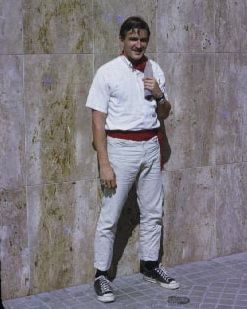
I was 22 and dressed for running at the running of the bulls in Pamplona.
I was 22 and dressed for the running of the bulls in Pamplona.

I will never forget a sunny Tuesday in July four decades ago in northern Spain. We drove into Pamplona at daybreak and gathered in the street by the town council building with hundreds of other young men in white outfits with red sashes, berets, zapatas and other adornments. José, my Spanish compadre, and I wolfed down a bag of churros and a liter of cold milk. Most of the crowd had been up much of the night drinking wine and snacking on garlic. We were there for the “incierro,” running in front of the bulls, a part of the Fiesta de San Fermin.

When the cannon sounded, we ran with the crowd up the street toward the Plaza de Toros, the bullring. In what seemed like less than a minute I heard the pounding of hooves on the cobblestone behind me and I quickly plastered myself in a doorway along the narrow street looking backwards as the two longhorn steers (the guides) and eight fighting bulls stampeded by us. It dawned on me just then that you could get seriously hurt doing this and in fact, 37 were hospitalized the very next day. Like most young people who do this, I remember the event with some sort of silly pride at having survived it. I was terrified at the time, but of course, had to act like it was no big deal. In Spain and many other nations the running of the bulls provides a way to transport the bulls from the railroad to the bullring. The fact that people willingly get in the way has resulted in a longstanding tradition particularly associated with Pamplona.

Recently, I learned that ten communities in the United States are hosting the Great Bull Run in 2013 and 2014 along with a Tomato Royale battle. Richmond, Virginia hosted the first one in August 2013 at a motorsports park. When I first heard about this, the lack of traditional context or purpose made little sense to me. Merging the running of domestic bulls with a tomato fight like the one seen in La Tomatina Festival of Buñol, Spain, makes even less sense.

Dasha crews dance and sing during an evening parade of the dashas in Fujinomiya as part of the Mount Fuji Festival.
Dasha crews dance and sing during an evening parade of the dashas in Fujinomiya as part of the Mount Fuji Festival in Japan.

Community events tied to community traditions (like Mardi Gras in New Orleans or the Mount Fuji Festival in Fujinomiya, Japan) are a part of the fabric of the community and add to the rich cultural heritage of the area. Events that encourage positive health and recreation benefits or stimulate public consciousness about a cause (such as Tour de Fat by New Belgium Brewery or the Sustainable Living Fair in Fort Collins, CO) can be great fun and serve a purpose at the same time. But creating events that are designed simply to make money, simulate danger or have the potential to cause harm to animals in an urban setting seems particularly ill conceived. Copying events from another community is rarely as good as creating something unique that ties to local cultural traditions or positive objectives to improve health or raise awareness of local issues.

Events are a part of the intangible heritage of a community. They can strengthen a sense of place if they make sense within the context of the community or they can create dissonance if they seem out of place. Is this ten-city running of the bulls really a good thing for an urban community? Will the event become a valued part of the intangible heritage of the community? I will hope these bull runs and tomato battles will be short-lived, but who knows? American culture often is a hodge-podge so we will see. If it works for the promoters, perhaps a new tradition will be born, whether it makes sense or not.

Communities and institutions always have the opportunity to create events that recall their traditions, culture and real stories. We are at our best when sharing authentic or near-authentic experiences that reinforce the sense of place and promoters can still profit – a true win-win situation. When we create “real fake” experiences for fun and commerce as a community or institution we likely accomplish little of value other than to enrich the event organizers. Participating in the American Great Bull Run costs $60 a ticket in 2014. Who knows how much will be spent by the participating cities for extra security and other public services? Participation in Pamplona is free, considered part of a community festival. These large events require community cooperation. I hope that most communities learn to just say NO when this kind of idea arrives. Come to think of it, perhaps that’s what I should have said when my Spanish friends suggested that we run in front of the famous fighting bulls of Pamplona, but there it is a tradition and I  chose to run.

– Tim Merriman

Professionalism – Six Ideas to Consider

Ange, a professional guide in Rwanda at Nyungwe National Park, also works with young people learning about birdwatching and guiding.
Ange, a professional Certified Interpretive Guide in Rwanda at Nyungwe National Park, also works with young people wishing to learn about birdwatching and conservation.

Several years ago we were in the Galapagos Islands leading an ecotour along with our local guide who grew up on the islands. He admitted to having some interpretive training but it was not evident in his performance. He glibly told us the names of things with no explanation of their role in the ecosystem and no attempt at a thematic approach. He walked way out in front of his much older clients and returned to the panga well before we did, anxious to get back to the big boat. He never emerged into public space on the boat to chat with us unless leading us on a specific hike or snorkel, and then he refused to answer any questions that anyone had already asked, berating those who apparently didn’t listen. He told us up front he was tired from a long sequence of tours so we shouldn’t expect too much from him. He was obviously bored with the subject and his guests, giving only the bare minimum. By the time we’d spent ten days with him, we were just as bored with him. His tip reflected that unprofessional performance as most of us left less than we would have had he done his job well or even pretended to enjoy his time with us.

One of the common definitions of a professional is simply someone who is paid to do a skilled activity as compared to an amateur who does it for fun. Was our guide a “professional” because he was paid full-time and knew the wildlife? I think there are a few ideas or “principles of a professional” that go way beyond payment or full-time employment. In the U.S. alone, there are more than 250,000 docents and volunteers who interpret nature, history, science and space at museums, zoos, aquariums, nature centers, world heritage sites, science centers and historic homes. Many are well trained and do their jobs as well as anyone who gets paid as a “professional.” Tens of thousands of seasonal interpreters and guides work at those same sites, but are considered “professionals” for just the season.

I have some other ideas about what makes us professional. Here are six points to ponder:

  1. Professionals do the job when it needs doing – Whether we’re on duty, on lunch break, going off duty, or on a day off, if we can help someone in our area of expertise, we do it cheerfully.
  2. We are committed to life-long learning so we keep up with recent research and new books and participate in advanced training events. Our knowledge of both content and process grows throughout our careers and we seek opportunities to learn more instead of declaring that we’ve been so well trained there is no room for improvement.
  3. Pros get involved in learning networks and associations to share what they know and learn from others.
  4. Professionals seek credentials, certifications and degrees that demonstrate advanced competencies whenever reasonable and possible.
  5. We behave ethically in all situations, understanding the complex responsibilities of representing an organization, caring for the resource and taking care of clients.
  6. Professionals work toward a balanced life of intellectual and emotional pursuits personally to be healthy, fit, and prepared for daily responsibilities.

I could not in good conscience put “being paid” in this list of principles. I’ve known volunteers who perform as professionals every day in every way. I’ve heard so-called professionals grouse about their jobs to the public, ignore visitors while they were at work, behave unethically and pass up easy opportunities to earn a credential or learn more out of sheer laziness or arrogance.

Professionalism is a personal choice. I’ve known talented people who never make the effort to learn from others or participate in professional networks. Some very talented natural communicators never reach their full potential because they stay out of the “profession,” viewing themselves as professional because they get paid. We can choose to behave as professionals or simply settle for being a paid worker in our field. I think the rewards of professionalism are continuous and powerful, but you have to show up and take responsibility for yourself and your actions.

– Tim Merriman

The Butler Did It – Everyday Heroism

We recently sat in a theater in Keauhou, Hawaii, watching The Butler. Most folks applauded at the end for a writer, cast and crew that could not hear the praise. We wanted each other to hear it, to share the moment. Most sat still and watched the names of all who made the film roll by on the screen, tears streaming down our faces.

Movies can entertain, annoy, and provoke us. They can interpret our culture in a unique way that only mass media can. The Butler took me back to the sixties and reminded me of how painful, thought provoking and energizing those times were. Cecil’s story is based on a real story of a butler at the White House, powerfully traversing time from 1926 forward to the election of President Obama. His sacrifice and ultimate rise to recognition are poignant and powerful reminders of what may be required of those who must endure to overcome adversity.

Many of us who were college students in the 60s had parents who lived through the depression and very hard times. Cecil Gaines picked cotton and received no formal education. My father had a 7th grade education and went to work on the railroad at age 13 to help support his family. Those kinds of experiences created strong people who valued education and worked very hard to create opportunities for their children. We, their children, had no historical perspective and wondered why they were so hardened and stoic. We could see the injustices around us and screamed about them, while they endured pain quietly. What we didn’t always realize was that we had the freedom to be insulted by what we saw because what they endured gave us that freedom.

In The Butler, a major theme is the classic father-son conflict. Oprah Winfrey plays the long-suffering wife and mother caught in the middle. Lewis, the son of Cecil Gaines, is an activist, a freedom rider, a Black Panther, who accuses his father of complacency. Cecil is a butler to five presidents in the White House, serving faithfully, yet influencing events in his own quiet way. Oprah Winfrey and Forest Whitaker bring such depth to their roles that the viewer shares their frustrations and heartaches. Those of us who lived through those times experienced the news of the assassinations of President John F. Kennedy, Bobby Kennedy and Martin Luther King and the loss of family and friends who served in Vietnam. Those were painful events that we felt deeply and this movie successfully took us right back to that pain.

Great movies, such as Gandhi and Schindler’s List, interpret the past and make us think. They help us process complex events and people. They remind us that not everything is about US. We occupy a larger world where many lack the chance to eat regularly, be educated and experience the most basic freedoms. The Butler made me think once again about our personal responsibility to help others and protect the unprotected.

– Tim Merriman

Try to Remember – Keep a Journal

I am reading Undaunted Courage  by Stephen Ambrose and the wonderful journals of the men on the Voyage of Discovery from Washington, D.C. to Oregon coast with Lewis and Clark left us amazing accounts of their journeys. Where would we be without journals?

It was ornithology class in college that made me start keeping a journal of each outing. That was great training that I used in my early years as a park naturalist. However, at some point I became too lazy to keep up the journal practice. It was all hand writing in those days and my best work was neither fascinating reading or very legible due to lazy penmanship.

The costumes are beautiful  Tibetan formal ware, but the ladies are from some other part of China, enjoing holidays at Jiuzhaigou.
The costumes are beautiful
Tibetan formal ware, but the ladies are from some other part of China, enjoing holidays at Jiuzhaigou.

But international trips revived my interest in recording every detail of a day. I wanted to be able to look back and recall the place, the people and the sense of wonder. It was twenty  years ago that my opportunities to travel internationally increased and a laptop had become my constant companion so legibility was no longer a part of the challenge. I type well at 80 words per minute or better.

In 2005 we were in China training about 30 world heritage site managers while touring on a luxury bus in northern Sichuan Province. We stopped to visit the very famous and highly popular Jiuzhaigou World Heritage Site and Biosphere Reserve. My journal from that first day follows:


The huge plaza at Jiuzhaigou would hold 5,000 people and needs to. That many are standing in line to get in each morning. They let 12,000 per day into the valley and the queue is a Disney model with the zigzag queues with cords between posts. This feeds into a bus boarding lane and 260 large green buses take people up valley. They can get off at any time and get back on at any point by flagging a bus. This is much like Denali and adds to the charm of the place. The valley is forked so midway up you can take one branch or the other. We went up to the right at first and it terminates at a 540 hectare old growth forest with very large trees. It’s temperate rainforest with every surface covered with mosses aned trees growing out of the tops of old stumps or broken snags as in the Olympic National Forest in Washington State.


The waterfalls and pools of this valley are varied and beautiful and the trails take you along or over the water the entire way.

We visit the WC (toilet) and walk up through the old growth, enjoying the scenes. At concession platforms near the bus stop you can pay ten yuan and wear a Tibetan outfit to have your picture taken. That’s very popular and takes the first 20 minutes of our visit to the valley. The trip up valley to this point is 40 kilometers between heavily wooded steep canyon walls of two to threee thousand feet. They say the taller jagged peaks of the Min Range of the Tibetan Prefecture are about 10,000 feet elevation. You can see water flowing beside the road the entire drive up. It turns out that Jiuzhaigou is one continuous waterfall from top of the valley to the bottom with intermittent lakes, roughly 40 kilometers. It’s karst topography so the gushing water is eroding the landscape into elaborate combinations of surface sinkholes and shelves with pools. The colors are amazing. The boardwalk trail zigzags the entire length of the river from top of the valley to the bottom and Visitor Center. Walking over karst pools of teal and azure teeming with trout is breathtaking. Nine Tibetan villages thrive in the valley within the park.

And it goes on and on. As a writer of fiction and interpreter of natural and cultural heritage a journal is a wonderful resource. When you want to set a fictional story where you have visited, you have background information and a large collection of digital photos as reminders (55,000 so far). When writing non-fiction such as a blog or book, you have your own observations to compare to what you find by other authors.

Thousands of Chinese visitors enjoy the park each day.

Journaling is a great habit. I wish I could motivate myself to do it every day everywhere, but finding the time around home is challenging. We are off to speak at a conference in Chandigarh, India, in Punjab State in early October so my large file of trip journals will get larger. One of these days there’s a book that can be fairly easily assembled from these fascinating trips – running in front of the bulls in Pamplona, watching pandas breed in Wolong Valley in Szechuan, taking a pirogue up the Chagres River in Panama, swimming with sea lions in the Galapagos Islands, watching black-maned lions up close and personal in the Serengeti and traveling on foot with the Kwitonda Group of mountain Gorillas in Volcanoes National Park in Rwanda. But those are other stories for other days.

If you want to remember where you have been, what you have done and people you have met, take twenty minutes or so every day and write (or type) in your journal. Add drawings if you are artistic or photos if your journal is electronic. Your journal will keep your memories alive and easily accessible, for yourself and to share with others. And who knows? Maybe one day your journal will be as famous as those of Lewis and Clark.

-Tim Merriman

Training Guides to Interpret

We were walking down a path through a beautiful botanical garden many years ago and our guide was talking over her shoulder with only a few able to hear. When she stopped she would start talking and not wait for the group to gather. When asked a question she could not answer, she pulled a notebook out that was tucked under arm and looked up “the facts.” She became one of our examples of “poor guiding practices.”

guides
Hope (left) and Julius Cesar (right) proudly wear their CIG pins after completing the course in Nyungwe National Park in Rwanda in 2013.

Everyone in our group was a professional interpreter or environmental educator and we asked about the notebook. She explained that was the training manual for guides, the big book of facts. They had been trained with content, but not process. Content is important and I think it is fine to have content experts visit with guides or interpreters and provide more meaningful understanding of plants, animals, history, universe or other subject matter to be interpreted at a given location. In fact, good guides will continue to be build their knowledge of content throughout their lifetime, but their process can improve with some thoughtful coaching.

The Certified Interpretive Guide course with National Association for Interpretation (NAI) was designed to teach the process of interpretation and encourage trainers to coach their trainees into better practices. Lisa Brochu and I developed the curriculum of the program in 2000 after a thorough review of other training available through agencies, universities and notable trainers. The resulting curriculum includes many of those sources (used with permission) as well as original material that came from our own background in providing training to interpreters at sites we’d worked as staff or consultants.

Dr. Sam Ham points out that your members of your audience might actually retain less specific information (facts) from a program if you are successful in getting them to think more deeply about the theme of the program. When people are truly engaged in an internal conversation because someone piqued their interest and engaged their desire to understand an idea, they may not even hear what else is being said for moments.

Great guide training should also get individuals engaged in more than memorizing facts. Modeling good interpretation with lots of interactive components will keep trainees engaged. They will have a better experience with the training if it is interactive rather than a straight lecture and so will better understand how to apply what they’ve learned in their own guiding.

Any tour company, park, zoo, museum, aquarium, nature center, historic site or community that employs guides or docents (volunteer guides) has an opportunity to advance their cause by improving guide training. You could send a staff member to NAI’s training to become a Certified Interpretive Trainer or hire those of us who have the credential and can teach the CIG course. We taught the trainer’s course for 12 years but now train Certified Interpretive Guides and Hosts for organizations and communities. Let us know if we can be of help.

-Tim Merriman

Five Ideas to Engage Your Audience

When I have the opportunity to speak to a group, my challenge is to find the most bored and tuned out person sitting in the audience and get him or her more fully engaged with whatever subject matter I’m presenting. Given that I’m usually trying to influence audience members to move toward greater stewardship of natural and cultural resources or understand science

Scott Mair of Victoria, Canada, is the master of audience engagement. This program in Korea combined the arts with weather interpretation.
Scott Mair of Victoria, Canada, is the master of audience engagement. This program in Korea combined the arts with weather interpretation and involved the audience in singing about clouds.

and research and value a thoughtful approach to decision making in the world, I believe it’s important that they pay attention and leave thinking about what they’ve heard.

Research tells us that getting people to think is the key to influencing their behavior in positive ways. If you want them to think, you have to get their attention, hold it and start a conversation. Here are five ways to do that:


  1. Get Organized – If you cannot hold their attention, it will not matter that you have a powerful message. Advance organizers, like a title with a hook, get people to show up with a good attitude and the expectation that they will hear something of interest. Introducing the theme of your talk in the introduction, developing it in the body and restating it in the conclusion is a powerful approach to getting and holding attention if your theme is strong.
  2. Relate to Audience Interests – You must relate to each person in your audience in a way that matters to them. Weaving both the tangible elements of your talk (things that can be seen, touched, smelled, heard or experienced with the senses) with the intangibles (concepts, ideas) will ground people with things familiar to them and lead them to the less familiar ideas you wish to introduce. Universal intangibles such as family, life, death, love and fear are more powerful in engaging people than jargon that will be understood only by a few in the audience. For example I could say, “Every cell in my body has the exact blueprints for another ‘me’ stored and everyone in my family has a similar set of blueprints
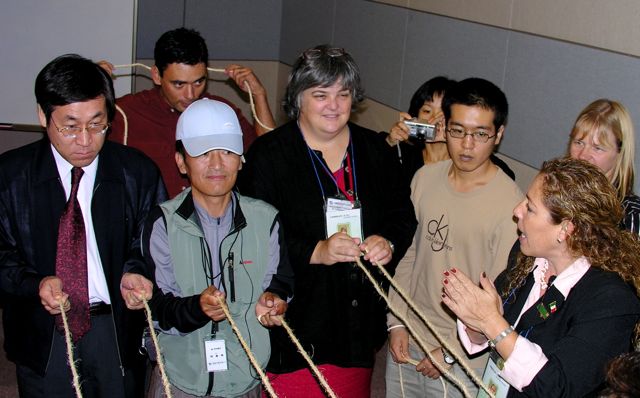
    Maria Elena Muriel had her non-English speaking audience totally enthralled as she invited the audience to build the warp of a loom from ropes to weave a giant fabric.
    Maria Elena Muriel of Mexico had her non-English speaking audience in Korea totally enthralled as she invited the audience to build the warp of a loom from ropes to weave a giant fabric.

    to mine resulting in our family resemblances, like big ears.” Or I could say, “The 46 chromosomes in the nucleus of each cell in my body contains a pattern of nucleotides that permit the exact replication of my physical/physiological structure and each member of my family have a similar chromosomal pattern to mine with minor variations related to their specific genotype and phenotype.” Unless I’m talking with other scientists, the first version is more likely to be something the audience will be interested in and understand.

  3. Be interesting – People are more likely to stay engaged if they are having an emotional reaction as well as intellectual stimulation. It doesn’t mean the subject and theme must be light and comedic. “How can each of us help prevent our children from being bullied?” That sounds like a heavy subject and hook, but any parent might have an emotional reaction to that discussion because it will answer some concerns they have about their children in school. Museums of Social Conscience like The Holocaust Museum take on challenging subjects and engage their audience, knowing that many people will come to a greater understanding of human tragedies and challenges through the emotional experience. Being entertainingworks with some audiences, but being interesting by stimulating both emotional and intellectual connections will keep your audience engaged.
  4. Ask Questions – When you ask your audience a question and allow them to answer, you start a conversation that is more personal than simply delivering information. By starting with an open question, you assure the listeners that you want to hear them and no answer is wrong. When you follow with a focusing question, you point them toward your message and invite them to think about your idea. Then you might ask an interpretive or processing question, which invites them to use their knowledge to come to some new conclusion. Last is the application or capstone question that leaves them with something to think about. “How might our climate be different, if we began using solar energy instead of fossil fuels to power the planet?” Socrates taught his students through questioning two millennia ago and it still works in getting audience engagement. Asking questions is one of the best ways to get people to think and pay attention.
  5. Encourage Participation – It can be as simple as asking an audience questions and having them give feedback by holding up hands or standing up. “How many of you can find Orion in the night sky easily?” That works even with a very large audience. Or you might try an activity with smaller groups to get everyone on their feet doing something. Bringing just a few audience members on stage to demonstrate something adds interest as their friends and colleagues will enjoy seeing them take part.

These are just a few ideas for engaging an audience to get them to think more deeply about your subject matter and message. You might enjoy hearing yourself talk, but your audience will stay with you longer if you keep their interests in the forefront. And I may not engage that fella on the back row who fell asleep, but I’ll keep trying.

-Tim Merriman

Five Ways to Build a Strong Membership

Twice in my career I have run membership organizations. In each case building membership was important to our work. And I learned a lot about that from others who had been building membership successfully for years.

These are five of the better tactics for building and retaining a strong and lasting membership in my experience:

A membership table manned by member volunteers works well at the entrance on high volume days (Dallas Arboretum).

Personal Selling: Everyone at the organization can be trained to invite people to become members. They have to know the benefits and accurately explain them. I’ll never forget receiving a business card from a colleague that had a brief membership form printed on the back. He considered every card he handed out a chance to get a member. Ask people to join every time you give a talk to a civic organization and track the percentage of your audience that joins.

Free Memberships: Give a membership to anyone who attends one of your special events, conferences, seminars or webinars. If you charge non-members more (as you should), make the amount equal to a year of membership so that they see your services for a year and hopefully stay part of the family.

Invite People to Join at Entry: If you have a gate fee or entry fee to property, start with “Members get in free year-round. Would you like to join today and get in free now and for the coming year?”

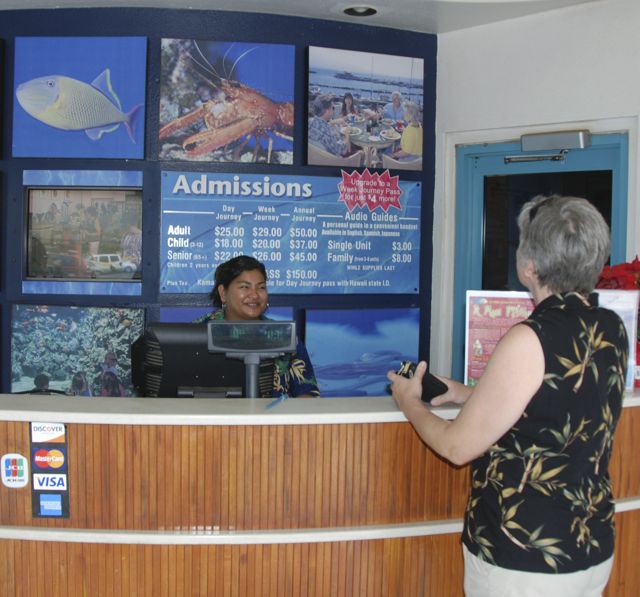
Showing the membership as an annual pass also works at entry (Maui Ocean Center).

Give Away a Trial Membership: Many organizations have found that asking folks to sign up that first time is the challenge. I once added a fee for use of picnic grounds at a nature center and to soften the blow of the change, we gave everyone who came out to picnic a free membership for that first year of change. It built goodwill and many later renewed on their own.

Offer Auto Renewal: If you give people the option of renewing automatically, many will take it. When that annual reminder comes, some people simply miss it or don’t get around to sending a check. Plan it so they can stay in your network as long as they wish without extra effort.

Membership may or may not be a large revenue source to support other activities. Often you must spend as much as you take in to provide benefits to members. However, they are also giving you money in annual campaigns, capital campaigns and as bequests in their estates. They are selling your organization to friends. They are your advocates when political problems arise. And some of them will emerge as major donors of long-term importance or volunteers.

They are your warm market, your family. Recognize them by name when you write about programs, recognize their gifts publicly on the Internet, in physical locations and with permanent markers when it makes sense for the size of their gifts.

There are many more ways to grow your membership but these five key approaches can get you started.

-Tim Merriman