What’s in a battery?

It is an exciting time in the energy innovations business. And I am wishing I had paid more attention in high school during physics class. It was my worst subject. I just did not know how to relate it to the real world. After a lifetime of applied physics lessons, I am actually learning how electricity works. Battery design and use has become my most recent study. Since we are building an off-grid solar house, batteries are required. Battery research has led me down many rabbit trails.


Right away I learned that lead-acid batteries have a limited life. They require regular inspection and addition of distilled water. They should not be drawn down too often or too far in stored energy. They must be recycled to keep the lead in them from being a hazard after they are no longer useful. Some innovative folks have been working on other, more environmentally-friendly options.


Nonagenarian Earl Bakken, inventor of the pacemaker, is converting his 17,000 square foot house to off-grid solar on the Big Island and getting away from diesel generators. His 176 kilowatt solar panel array will charge into a new battery type based on saltwater, not lead-acid. RES, our solar contractor is also working on his project and has taken on distribution of the new line of Aquion batteries to do his project and others. Our modest 1180 SF house will use their new S-20 batteries designed for small projects.


m100-ls81-homeThe Aquion story is innovation at its best and Dr. Jay Whitacre tells the story well in his 2012 TED talk. He worked for the Jet Propulsion Laboratory (JPL) as a post-doc after earning a Ph.D. in physics from Oberlin College. He became a senior staff scientist involved with the Mars Science Laboratory development team. His research into energy storage led him into experimentation with batteries based on using the most common elements on Earth. He invented the Aquion battery when he left JPL for a professor position at Carnegie Mellon Institute in Pittsburgh in 2007.


Eight years later the battery is in production and distribution with Hawaii being an important demonstration location due to the Bakken project, a microgrid-sized application. Aquion has attracted major investors in the past two years including Bill Gates of Microsoft fame. In 2011 Gates posted a blog article entitled “We Need an Energy Miracle.” He explained in that blog the need for a low-cost energy storage system to make solar and wind technologies more useful in diverse settings. Aquion is one of several approaches that show great promise so he invested.


Aquion makes a battery with no Haz-Mat implications. It requires no maintenance such as adding water. It lasts for 10 to 20 years and can be cycled up and down thousands of times. It is more expensive than a lead-acid battery system at the start, but should not be over the total cycle of 20 years. And it will be less expensive to buy each year as sales volumes increase and production costs are reduced.


In the early 1980s I was a nature center director employing solar hot water, composting toilets and a solar greenhouse to demonstrate new technologies. Many new trends we thought would endure did not, but nature centers are a great place to demonstrate and explore new technologies that show hope for a more sustainable future for the planet. New technologies offer a good opportunity for grants funding because they are one-time purchases with a sustainability value in support of the nature center, zoo or aquarium.


Batteries never looked exciting to me before, but they do now. And I am learning some of the basic physics principles I missed in high school. If you operate a facility or home in a sunny location, take a look at the options to go off-grid and start learning more about batteries. It really is an exciting time in the energy innovations business.


-Tim Merriman


Seven Tips for Getting Grants

A wordle.net creation

Sometimes grants seem to be the perfect solution to every need at nonprofits. I learned early on to be careful what you wish for when you apply for grant monies. Here are a few guidelines when thinking about going for grants.


  • When someone from a foundation or family trust offers money to your organization for their pet project, go slowly and be sure what they wish to support is something you would be doing if they were not helping at all. Be strategic even if it means turning down a large sum of money that is assured or risk drifting away from your mission.
  • Be sure you have the skill to manage a grant before you land it. Applying for funds with an exaggeration of your skills and abilities as a staff and board can backfire. If you get the grant and the granting organization is not happy with the level of competency at which you perform, your credibility with them will suffer.
  • Use grants to start new projects, especially those that create earned income, but do not expect to sustain the projects with grant funds. Most foundation executives will warn you in person or in their grant guidelines that they do not wish to provide ongoing operational support of your work. They want to help you become more self-sufficient or achieve important dreams. They worry and withdraw support when they see an applicant attempting to bridge the gap in operations year after year with operating grants.
  • Be sure you have the ability internally or with hired accounting services to carefully track grant funds. Most granting organizations will audit your work at some level and finding you did not spend their money as promised can result in damage to personal careers and the organization’s reputation.
  • Thoroughly research potential grant sources before applying. They publish guidelines that give you a clear idea of their priorities and you will not change their strategic directions even if your need is very compelling. Most foundations also have specific geographic regions within which they fund.
  • People give to people so personal relationships and thoughtful communication matters. Invite grant givers to your site to see what you do whenever they are in your area. I once asked our Congressman to invite statewide foundation representatives to our community, a region that few foundations had visited or supported. Each of them began giving in the community after seeing our local non-profit organizations in action. The congressman was the perfect host because he served on the Joint Congressional Budget Committee and they would not consider turning down his specific invitation.
  • Write a logic model for your project or program that identifies the impact, outcome and output objectives clearly. Many funders require them but most will appreciate knowing the measurable results you expect. A logic model that is well written clearly identifies how the results will be evaluated, another common requirement of grants.


Charitable foundations, government agencies and even corporations assist nonprofits greatly through grants, but dependence on them can be a problem. Their ability to help your group grow will decline in a recession economy. It’s important to balance grants with earned income, individual philanthropy and other sources. Remember that grants are not gifts – they require thoughtful shepherding throughout their life cycle, from initial research to final reports.


–Tim Merriman

Thematic Events

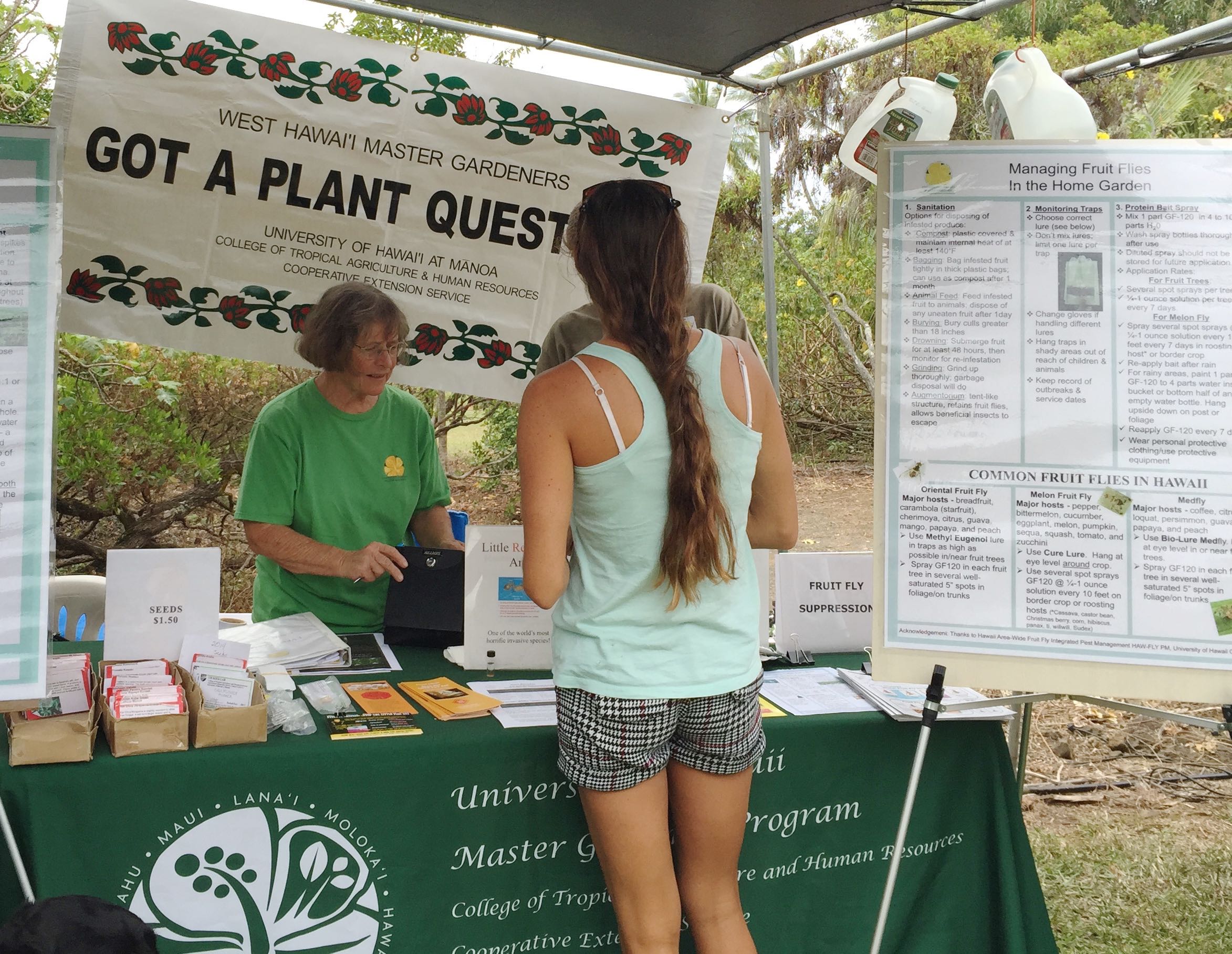
Master Gardners answered questions for guests about plants and pests.

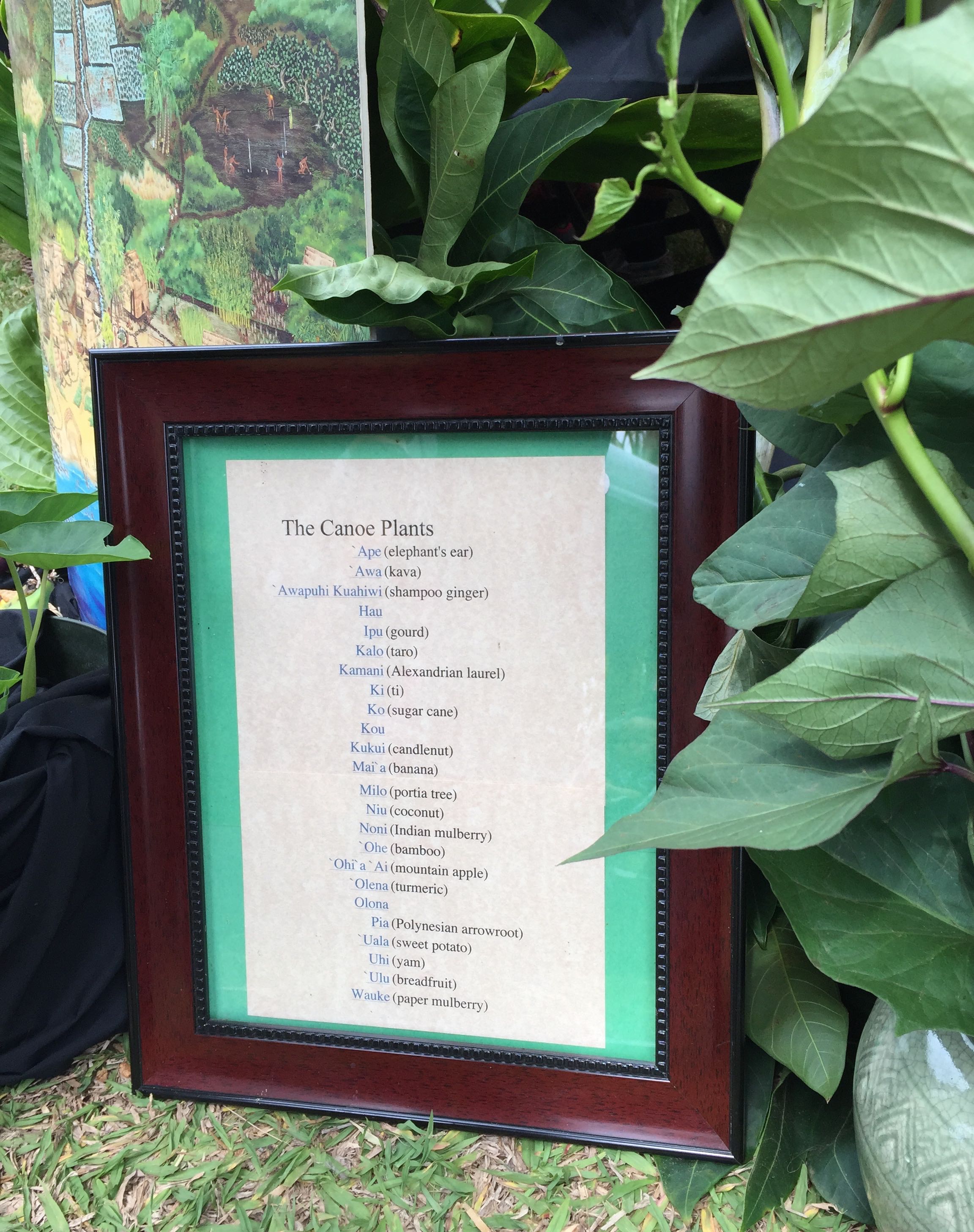
Last weekend we attended the 11th Annual Grow Hawaiian Festival at the Amy B.H. Greenwell Ethnobotanical Garden in Captain Cook. It was a celebration of Hawaiian culture and traditional foods. Almost everything at the event supported the theme. They made a point of focusing on the original 27 “canoe plants” known to have come with the early Polynesian immigrants to the islands. The first Hawaiians chose those plants carefully for the great value each provided as food, oil for light and fiber for clothing. This thematic event landed particularly well because the coordinators so carefully keep the booths and activities closely aligned with “grow Hawaiian.”


Making poi was popular with guest of all ages.

One booth invited visitors to make poi from kalo (taro) or ulu (breadfruit) by pounding it on a papa kui ai (wooden board with a trough shape) using a pohaku kui ai (stone pounder). People of all ages were trying the traditional Hawaiian method of preparation to make a smooth starch poi and each one could take home the resulting creation in ziplock bags. The gardens show the kalo growing so visitors make the connection between the food and the plant.


The lunch served at the event was a traditional plate lunch with Kalua pork and cabbage or lomilomi salmon along with macaroni salad, poi or rice and a tomato salad for $10, including the beverage. It was delicious, cooked and served by local families.


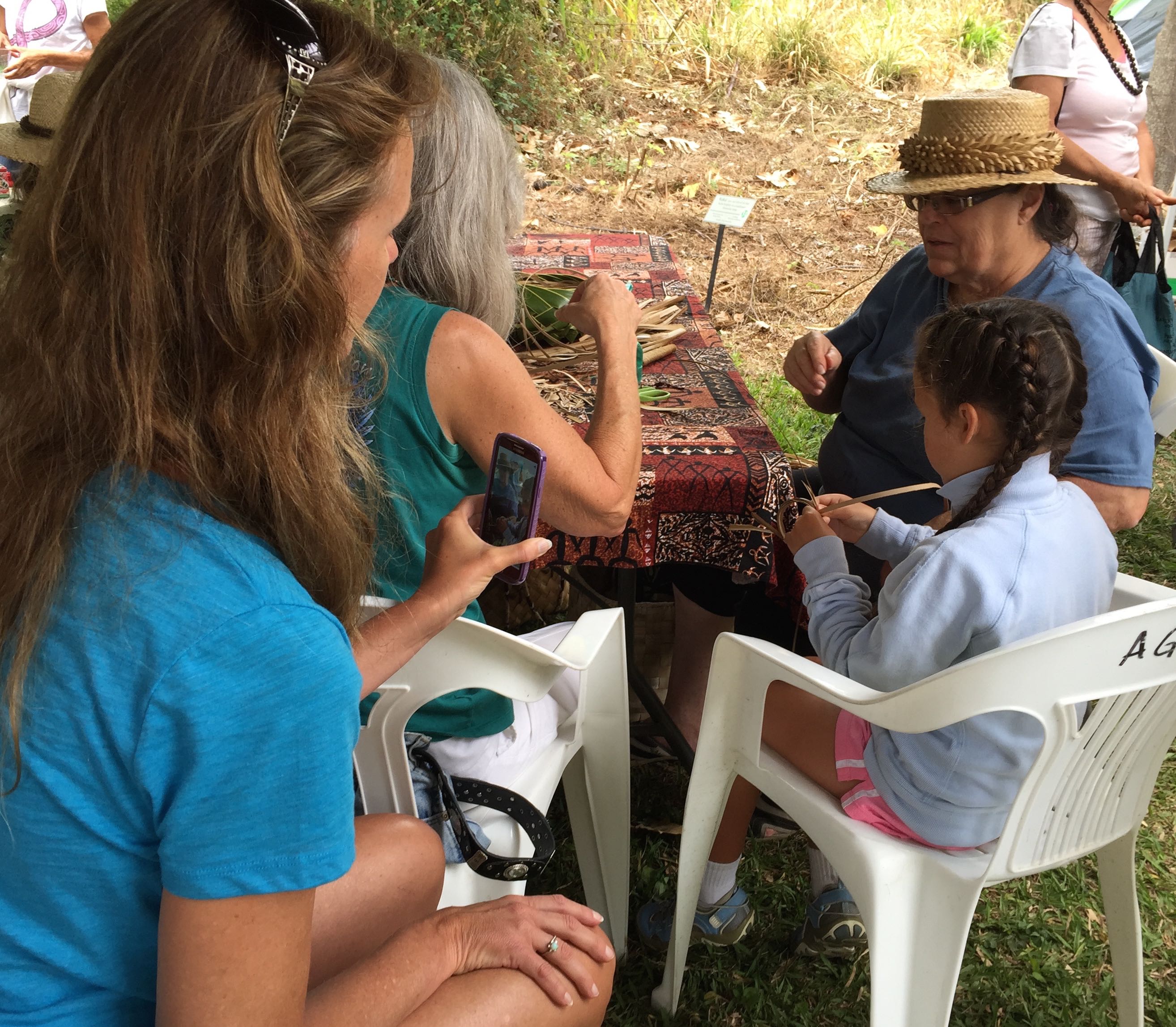
Parents captured their child's lauhala lesson by an elder of the community.
Parents captured their child’s lauhala lesson by an elder of the community.

I watched many parents of children using a cell phone to take a video of their child learning hands-on lessons on lauhala (pandanus fiber) weaving or making poi. The focus of the event is learning by doing and selling items is not permitted until the event has concluded at 2:30 PM. This well-planned and attended event will bring us back year after year.


The Big Island of Hawaii has a number of festivals year-round. The climate, scenery, culture and tourism make it profitable and useful to create outdoor events that tell a story, but some tell their story better than others. We have written about the Chocolate Festival and Coffee Festival in the past because they exemplify the power of thematic events to tell community stories.


The 27 canoe plants were selected for their usefulness on a long journey by canoe from the South Pacific to the Hawaiian Islands.

We have also attended recent agricultural festivals where the thematic identity was present in name only. The many artisan booths could have been set up at any marketplace to sell their wares. They are festivals in name only and do nothing for the community or branding of the host site.


Non-thematic events are not bad. They simply lack the personality that a thematic identity brings to the table. They are not very engaging for the community or the attendees except as economic events. Themes deliver a message, a reason to connect with the idea behind the festival.


Thematic events that match your natural and cultural history help in branding your organization and community. Think about your events and whether they help create your sense of place.


– Tim Merriman

Talking Story

I was walking back down the hill to our home in Hawaii after running, when a new neighbor smiled and said hello from her lanai just behind her house. She held a bunch of bananas and a shrink-wrapped package of macadamia nuts, gifts to a new neighbor. Flora and her husband have a family-run coffee and mac nut farm. We exchanged small talk for a few minutes to get acquainted. We were “talking story,” a Hawaiian reference to chatting and telling personal stories that reveal much about who we are, what we like, and how we live. Storytelling reflects and reveals our values, our hopes, our disappointments and our way of thinking.


Farmer's markets have become one of these important places to talk story in Hawaii and many other communities.
Farmer’s markets have become one of these important places to talk story in Hawaii and many other communities.

Talking story is a time-honored tradition here. I feel very much at home with the storytellers. As a young boy, I would be out with my father, a salesman, and would tug on his pants leg to go home as he chatted with farmers, neighbors, customers and anyone he met. I grew to appreciate his stories, some historical, some autobiographical, many humorous. The stories were well known in the family. I inherited them and have continued the tradition of passing them along. They express some of my beliefs and experiences with life or they just seem funny and a way to remember dad. When my son was very young he endured my long visits with friends and strangers, sharing stories, getting acquainted, talking story.


I love that the culture here has a name for this activity, but the activity itself is not unique to Hawaii. The small town where I was raised had several local cafes, which had daily coffee drinkers who gathered to “talk story,” known as the third place by city planners. These homes away from home included “regulars” and their friends or drop-ins, someone new to town or returning home for a visit. These third places are important in communities because they allow people to hang out, catch up with friends, and take time to understand each other better.


As a nature center director, I supervised building a restaurant next to the Arkansas River in Pueblo, Colorado. The center had been a popular daily stop for joggers, dog walkers, fishers, birdwatchers and nature lovers. A café added food, beverages and great places to sit with friends, un-hassled. It encouraged people to meet for lunch, stop by for a drink, hold a birthday party or even a wedding or funeral. I enjoyed talking story with our “regulars” each day. The restaurant added to our attraction power for people as a third place, not work, not home. We encouraged staff to take the time to talk story with visitors. It became an important part of the workday, getting to know people well, listening to their stories.


Think about how you might encourage opportunities for storytelling beyond the traditional exhibit space or program areas. That café, coffee shop, tearoom or picnic area that serves as a “third place” at your facility may become “the” place for talking story at your site and as such, an important place for creating a sense of community.


– Tim Merriman


10 Guidelines for a Useful Brochure


Rack systems managed by marketing firms can be an easy way to get your brochure in front of diverse audiences.

We once asked a state park office how often they have to fill their brochure rack. The enthusiastic clerk explained, “It’s great, virtually never. No one takes them.” Here are ten guidelines to keep your brochures where they belong, in the hands of your guests, instead of in the rack or on the ground.


  1. A colorful brochure with great illustrations attracts the eye and makes it more likely to be picked up in the first place.
  2. The title should telegraphically identify the brochure’s purpose or theme. If I need a site map, I want to be able to find it easily, but if I’m interested in the story behind the site, I may be willing to read a little more if the title is intriguing.
  3. Use illustrations and photos instead of words whenever possible. Pictures can often convey universal concepts, understood even by those who do not know the language.
  4. Make the folded shape and size convenient to carry in a pocket.
  5. Make sure the design is consistent with the distribution system. If your brochure rack has opaque covers across the lower half of the brochure, put the title or theme on the upper third where it can be seen.
  6. Make brochures readily available in a rack system or location where they are likely to be seen and used, not hidden in an administrative office where guests have to ask for them.
  7. Give people a place near exits to repurpose gently used brochures. Soiled ones can be put in paper recycling and clean ones reused.
  8. Make the papers and inks used reflect your values. Recycled paper and organic inks may be the best choice if your organization specializes in conservation stories, even if they are slightly more expensive.
  9. Think of who will use it and design to help them make easy use of the brochure. (e.g. larger print for seniors, digital app for young people, sized for convenient distribution).
  10. Hire a professional designer who knows how to use color, typefaces, spacing and overall design carefully. This may not be a project for an intern.


Enough said – Happy Valentine’s Day!


– Tim Merriman

Living Off-grid – A Lesson in Energy Consumption


In the early 1980s I was a nature center director in Pueblo, Colorado. The energy crisis nationally energized us to be early adopters and models of conservation measures. We put a solar hot water heater on the center, added clivus multrum composting toilets and built a solar greenhouse both as demonstrations and to show our commitment to our own core values. The technologies were somewhat clumsy and challenging to use back then, but we learned much from doing it and conducted workshops as part of our programming to teach others about emerging technologies that protect the environment.


Photovoltaic power has never been so affordable.

Decades passed and I moved on to be an association director. As private citizens, Lisa and I paid our energy bills and enjoyed the benefits of on-grid electricity at reasonable rates. In 2008 we used the exceptional U.S. and Colorado tax credits and Xcel Energy stimulus funds to add 48 on-grid solar panels to our home in Fort Collins. We had no electrical bill after that, except for a $7 clerical charge monthly. The system repaid us for hard costs in five years with the savings on electrical bills.


We just moved to the Big Island of Hawaii where we currently rent a home that is off-grid solar. Electrical power poles do not make it to this secluded location. It is actually a wonderful reminder every minute of the day that energy is not as free and easy as it seems in much of the United States. The normal cost for electricity of 42 cents a kilowatt-hour on the Big Island (3 times the mainland rate) encourages important choices in how you build and consume. We have decided to build our new bamboo house with off-grid photovoltaic cells, solar hot water and catchment water for irrigation.


Even a solar trash compactor can tell its story.

In the meantime we have four to five months in the rental house to learn how to manage our daily lifestyle with less energy demand. Our current daily use of electricity is:

Light (1 – 60 watt) – 2.5 hrs.

Refrigerator – 24/7

Microwave – 5 minutes

Blender – 30 seconds

TV/Dish controller – 2.5 hours

Computer/phone recharge – 4 hours

Printer – 5 minutes

Toaster oven – 45 seconds


We have no heating or air conditioning with lows of 62 degrees and highs of 84 degrees Fahrenheit. We have no dishwasher, clothes washer, or dryer, a choice you make when going off-grid to decrease electrical demand. It’s a climate where clothes dry quickly outside and we just do not wear as many clothes with shorts and a T-shirt as the preferred daily apparel. (Lisa notes that she does wash clothes, but by hand, as needed, in the bathtub. It takes roughly one hour per week.) We cook with propane and have on-demand propane-fueled hot water.


Hawaii offers opportunities to lower our energy demand and live with no connection to the grid for a reasonable investment in photovoltaic solar power and hot water. The tax credits make it all more affordable and new technologies keep lowering the cost. Solar panels that cost $350/watt produced two decades ago are selling for $1/watt now so the opportunities to use solar on or off-grid have never been greater.


People like learning about your extra efforts to protect the environment.

Nature centers, aquariums, zoos, museums, and parks, which use solar and other appropriate technologies make a valuable contribution in stimulating people to think about new options. When you employ these technologies, be sure you create the exhibits and other media to share your reasoning and the costs involved. Adding programs that help people learn how to do it can be very popular.


Climate makes going off-grid challenging in most places but year-round warm climates offer a great opportunity for people to return to a simpler way of life by making a few different lifestyle choices that are healthier for humans and for the planet. For more information, check out Home Power magazine to get more acquainted with the burgeoning technologies.


– Tim Merriman


Gift Shops – Eights Ideas to Consider

Great gift shops extend the learning experience in a community or at a natural science or cultural site. They encourage us to invest and take home a symbol of the visit. These are traits that you might consider in planning or revamping your gift store.


gift11) Sell fair trade goods, sustainably crafted, with enduring value. Guests notice whether your sales items support or are in conflict with your organizational values.

2)  Sell experiences that support local or site-based themes. Experiences such as off-site tours, visits to dinosaur digs, and behind the scenes tours can be booked from the shop using an exhibit to pique interest.

3) Stock memorabilia in a broad price range. Items can be as inexpensive as a polished local rock or a unique T-shirt or as expensive as a locally handcrafted item, but every item should be related to the place or message regardless of price.

4) Use the gift store as a learning place that helps guests better understand the stories and mission of the community or organization. Signage and exhibits in a store help people make informed choices about what to buy that might improve their experience at the site or support a local community group that deserves assistance.

5) Support local craftsmen, artisans, and fabricators to build a

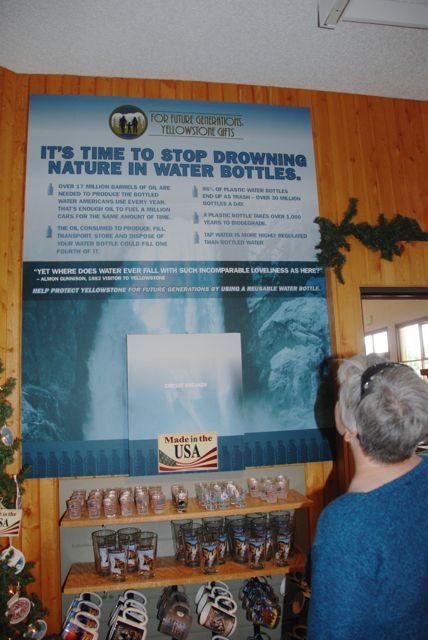
Xanterra also employs exhibits in the gift shop to encourage thoughtful choices in using water bottles.

sense of community related to your natural or cultural history site or heritage community. You can keep art and craft skills alive related to your story and purpose for the benefit of all. Hangtags with names and personal stories of craftsmen who made them help people remember the experience and the message long after their visit.

6) Be sure your bags match your organizational core values. Encouraging wildlife conservation and then requiring each customer to carry away their purchases in plastic bags creates dissonance they will notice. Consistency is important in everything you do.

7) Design your shop around the exit so people walk through it as they leave. Studies of museum stores have shown that sales are ten times as much if people exit through the store when compared to an exit with a side door into the store. If this seems like crass commercialism, then you may not be selling the right stuff.

8) Some portion of the sales items should extend the learning experience. Books, videos, maps, charts and I.D. cards provide people with the next steps in growing their knowledge and passion.


A great store extends the experience for guests in wonderful ways. A poor store that seems designed only to sell “stuff” can degrade a good experience. Make your experience even better by a thoughtful assessment of your store’s power to extend the learning experience.


– Tim Merriman

Message Your Waste

Locations where people throw away items or use bathroom facilities can be great opportunities to send messages that matter. Here are nine thoughts on creative ways we see messaging of varied kinds at facilities the public almost always has to use wherever they go.


  • Art in bathrooms or on recycling centers can help tell your story. Visual art communicates to people of all cultures as a universal
    Tile in bathroom at Xanterra operated lodge in Yellowstone National Park.
    Tile in bathroom at Xanterra operated lodge in Yellowstone National Park.

    language. The art can simply be thematic reminders of where you are and the beauty and key features of the area or it can provide a detailed representation of your theme without words.

  • Explain what happens next to recycled materials or human waste and how that benefits the environment. “We compost your cups and plates to nourish the soil created in our gardens.” OR “This is a composting toilet that converts human waste into soil.”
  • Give the BIG PICTURE such as the total amount of waste daily to be handled and processed. Fun facts can provide an impressive overview that may make stimulate guests to think about the impact they have.
  • Give guests an idea about how they can help immediately – “Get your cup refilled instead of taking a new one.” OR “Refill (or recycle) your water bottle here to reduce the number of plastic bottles that find their way to the landfill.”
  • Add a TAKEHOME message that suggests how people might reduce
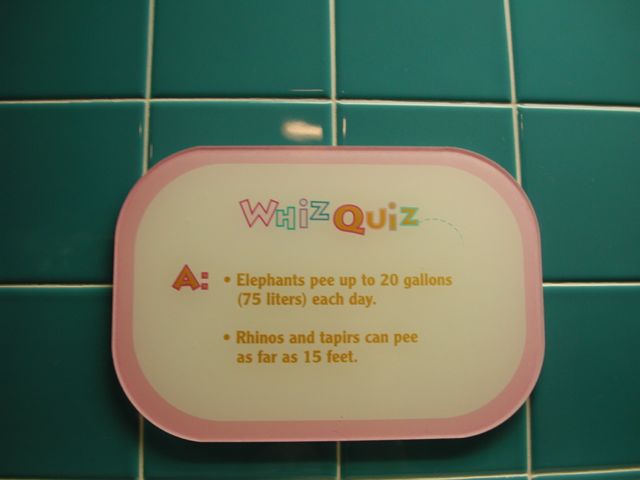
    Disney's Animal Kingdom has great messaging in the restrooms.
    Disney’s Animal Kingdom has great messaging in the restrooms.

    their waste stream at home. In the United States, explaining that tap water is tested continually and of very high quality helps people understand that bottled water may not be their best option, both for safety and for reducing the waste stream.

  • Share program messages in bathroom stalls, above urinals, and on bulletin boards on or near bathrooms. We all have need of disposing of human waste several times a day. Having something to read in the bathroom related to the site experience can be both useful and enjoyable.
  • Explain the implications for the community or wildlife if we don’t do better with handling solid waste of all kinds.
  • Take your messaging opportunities a step further by being
    Recycling containers are great locations to extend guest understanding of solid waste implications on the environment.
    Recycling containers are great locations to extend guest understanding of solid waste implications on the environment.

    consistent with the products you offer in your shops. Provide refillable drinking containers instead of bottled water, and paper or biodegradable cornstarch bags instead of one-use plastic bags for sales items. Avoid offering low-quality or inappropriate items that do nothing to support your theme and end up as trash.

  • Be careful that your own maintenance matches your message. Make sure your staff understands that the public follows your lead. If they see staff empty a recycling container into a trash dumpster or water being wasted adjacent to a sign about keeping water clean and using it minimally, they are likely to do the same. It may cause them to question your other messages as well.


Your messages matter more if well planned and executed. If you need help with that, let us know.


– Tim Merriman

Community Funded, A Funding Place

bikelibraryHow do you save a valued community organization that runs out of funds despite the good work it is doing? How do you tell its story to the people who might care the most and want to help? How do you turn crowds with common interests into communities of support? Communityfunded.com is helping do just that.


The founders describe how it happened: We are a coffee shop owner, a math tutor, an artist, a programmer, a social media gal… all donating our talents and time toward the vision we share. What started as a back patio discussion over beers, became months of “16 Hour Saturdays” in a spare room of a house, which became a team of ten people working in the basement of a coffee shop… which will become a worldwide economic revolution that empowers every human on the planet!


In Fort Collins, Colorado, McCabe Callahan, owner of Mugs coffee shop, and math tutor Blue Hovatter hatched the idea for CommunityFunded and pulled in friends as collaborators. Since 2011, it has involved almost 8,300 people in support of more than 1,000 community projects in 50 states and 176 cities.


Crowd funding is not new. Sites like Kickstarter.com and Indiegogo.com are well known to most folks who follow tech trends in fundraising. But the focus of Communityfunded.com is unique. They have made it easier for good ideas that build community to get needed financial support. They explain: Our tools empower you and your community to come together and create lasting impact on things you care about. Our vision is a world empowered by connected communities.


The Fort Collins Bike Library (FCBL) is a favorite local project for folks in Fort Collins. The library checks out “free” bikes to locals and visitors much like a lending library of books. When the library was out of funds in 2012, Communityfunded.com ran a campaign to keep it alive and thriving. With 178 supporters and $100,720 in gifts, the FCBL was secure for another year with community support. It was a great test case and proved the power of local funding.


The fees levied by the site are 8.2%, a minimal cost for bringing funds from diverse sources together to do something good for a community. The website clearly identifies the recipients of funds as either 501(c)(3) non-profit organizations, “neighbor-in-need” or community building projects. Project Heroes are recognized as organizations or individuals who provide substantial support through the website.


Fundraising of any kind is challenging. The mechanics of promotion, collecting funds and reporting success is made easier through this unique crowd sourcing website. This may be the place for you to start your funding for a community project.


– Tim Merriman

The Bad Guide, A Parody with a Purpose

Ace leaves his guests to catch up as they can near Lake Tahoe.

Those of you who have been to guide or trainer training with us may remember Ace Adventura, my alter-ego, the bad guide. I like portraying this rogue interpreter because he provides a chance for guides and trainers to critique guide performance with no concern for hurt feelings. Ace intends to be bad and is. And yet virtually every antic of my performance is something I have seen in practice by a guide at a natural or cultural history site.


I like to do about ten minutes as the bad guide, and then explain as Ace that I have to leave early for an obviously inappropriate rendezvous with a young lady. I take over as myself just two minutes later after improving my appearance. I then attempt to give the “good guide” thematic interpretive talk along the same trail. I always hope the contrast is extreme enough that everyone can see the difference and think about what made the difference.


Just a few but not all of Ace’s transgressions include:

Show up late

Wears sunglasses

Toss a coffee cup on the ground

Dressed as a slob

Terse formal introduction

Does not allow questions

Walks too fast

Talks facing the resource not the audience

Leaves guests facing the sun

Too much scientific jargon

No discernible theme

Takes a personal phone call during the talk

Talks down to guests

Asks for tips

Inappropriate humor

No conclusion

Ends the guided hike early for personal reasons


As the good guide I try to:

Dress appropriately

Have a clear theme throughout

Use questioning effectively

Create conversations with guests

Invite their questions at any time

Use universals and language familiar to guests

Encourage them to think about where we are

Provoke further thought or action

Take care of guests appropriately with weather, speed, etc.


After the ten-minute good guide effort, we go back to the classroom to debrief. I first invite a critique of Ace and that’s usually fun and engaging. Guides or trainers enjoy sharing what he did wrong and there is a lot to talk about.


I also invite the class members to tell what they liked about each talk and critique the “good guide.” We are rarely perfect when doing our best work and listening to thoughtful criticism is good for all of us.


Many trainers have shared photos and stories of their personal “bad guide” character over the years. If you train guides, consider using a bad example as an opportunity to talk about the many things that do not work well. A really good guided activity is so engaging that it is often challenging to critique it. You get engrossed in the experience and forget to analyze why it is so good. A truly terrible performance will make you think about why we need to be good at this.


Happy guiding in the New Year – 2015!


– Tim Merriman