Seven Ways to Connect with a Large Audience

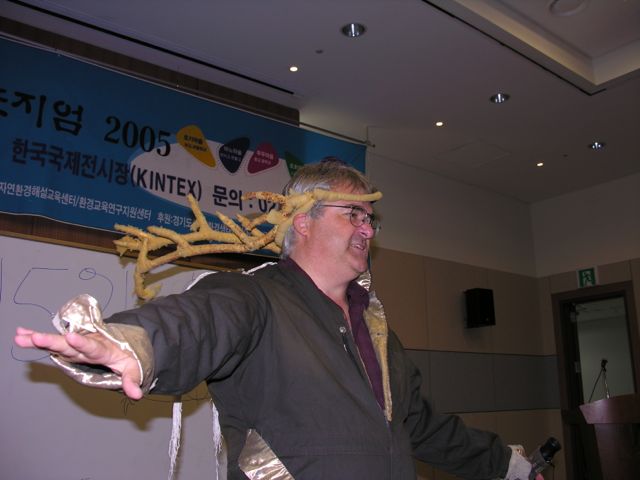
Have a mike ready when inviting comments. Jay Miller is sharing a comment in Seoul, Korea.

My wife says that I can sleep anywhere. I’m pretty sure that is true. I slept in church as a kid, snoozed my way through large lecture halls in college, and I’ve never survived a planetarium program without a nap.

It’s easy to look out at a very large audience and lapse back into lecturing even if you routinely use questioning in your work to get people engaged. It seems daunting to be interactive if 500 or 1,000 or 3,000 people are looking at you, perhaps watching you on dual projection screens and listening to your amplified voice.

There are still some great options to helping your audience feel more involved. Here are seven ways you might keep most of your audience and even people like me paying attention.

  1. Take a poll – Ask questions that lead into your thematic presentation that have yes or no answers and ask for people to put up their hands or stand up. “How many of you have seen a bald eagle in the wild? Just hold up your hand if you have.” This is a great way to do some on the spot market research. You can find out if they have visited before, what they enjoy, and what they would like to know or do. Just the act of standing up gets them involved, engages their minds and shows that you’re interested in what they think.
  2. Honor members of the audience – Ask someone to stand up and tell a story about her or his achievements. Let them know before the presentation you will ask so they are ready. You can honor more than one at once. I was often host to an audience of 1,000 on Veteran’s Day and would ask all veterans to stand and then invite the audience to thank them. It was a good way to recognize the holiday, the veterans and set a tone for the morning program. You might ask all who have won an award or whohave made a major donation to stand up and be recognized.
  3. Sing a familiar song with the group – I was astonished when I attended a Prairie Home Companion performance in San
    Scott Mair is the master of getting audience involvement through songs and audience participation
    Scott Mair is the master of getting audience involvement through songs and audience participation

    Antonio at a beautiful old theater. Garrison Keillor’s program was quite good, but the intermission was even better. He stayed on stage and sang songs with the audience. I did not get up to take a break and was glad I did not. I raced out for a restroom break immediately after the intermission, but I came back for the second segment as quickly as I could with renewed interest. He brought the audience closer together with the universals of songs common to our culture. It was wonderful to look at people on either side smiling back, humming when they couldn’t remember all the words.  Home on the Range brought down the house, as they say.

  4. Invite questions from the audience – If you do this, be sure to have people with cordless mikes standing by to allow everyone to hear the question or comment of audience members. This keeps you on your toes as a presenter as you attempt to respond thoughtfully to the questions that are asked, and keeps the audience listening to your candid answers with real interest. Be sure to thank those who participate.
  5. Ask a challenging question – if you do this, consider having a gift for the respondent. It could be the book you wrote, a fun t-shirt, or a wrapped chocolate truffle or something symbolic, like a squeezable toy in the shape of something related to the theme of your talk. If it’s something you can toss without risk of hurting anyone, audiences seem to enjoy trying to catch or watching others catch the item.
  6. Try working without a net – Use your speaking ability and physical presence to command attention instead of relying on Powerpoint presentations. Unless the images you can project are truly necessary to illustrate your program, you might find that your audience can pay attention more easily to your face, voice, and body language. Go down into the audience wearing a portable microphone and talk directly to individuals, always moving your attention (Hint: Watch Ellen DeGeneres on TV for ideas).
  7. Bring some up front to take part in an activity – Involve some from the audience and their friends will pay even more attention. Those who take part will enjoy the attention. Others will wonder if they might be next.
Maria Elena Muriel had many in her audience build the warp of a loom from cords to demonstrate weaving.

There are, no doubt, other ways to keep a large audience presentation from being a boring lecture. Think about what you might do that challenges the audience to stay involved, to think about and process what you are saying.

And if you need me there in the front row as a test of how interesting your program is, just let me know. I never intend to take a nap, but if you can keep me awake, you know just how good you really are.

–Tim Merriman

P.S. All of these photos were taken in Korea in 2006, when the Korean government invited interpreters from many agencies and nations to demonstrate “hands-on learning” to communities and universities.

Akagera National Park and Ruzizi Lodge, a Wildlife Experience

waterbicl

We recently visited Akagera National Park in northeastern Rwanda to fill in our understanding of the amazing progress being made in this small nation to protect important habitat and wildlife populations.  Akagera, named after the river of the same name, includes montane forests, savannah and wetlands in its 1120 square kilometers. The park was badly damaged during the civil war in 1994 and in the following years when half of the park was made available for settlement and agriculture. Although the park’s area shrunk, it still provides viable habitat for many of Africa’s savannah species. which are slowly being re-established.

On our brief visit, we were quite taken with every aspect of the park. I smiled when I read a scathing complaint on Tripadvisor.com about tsetste flies in the park. The writer must not have ever been among wildebeest and zebras in Tanzania or Kenya during migration. Savannah parks all have tsetse flies, but the amazing experiences are worth the minor annoyance. Akagera has incredible birding, antelope populations (topi, eland, reedbuck, bushbuck, impala, and sittatunga), buffalo, elephants, zebras, giraffe, and black rhinos. The wetlands are amazing with lots africanwattleploverof hippos, monitor lizards and wading birds. We enjoyed the wildlife watching very much.

The big cats are, for the most part, missing, though leopards are occasionally sighted. The park managers hope to restore lion populations in coming years. The Stichting African Parks Foundation and their U.K. and American non-profit affiliates manage the African Parks Network, which provides primary funding for selected parks throughout Africa. They took over Akagera in 2010 in partnership with the Rwanda Development Board. This great program takes on some of the most challenging parks in Africa and provides conservation management and careful business management to rebuild them. They work under a 20-year partnership with the government to make the park operate sustainably to give it the best chance of long-term success as a viable conservation area that also provides and encourages tourism opportunities.

topiWe had the opportunity to sit down with Jes Gruner, Park Manager, and Sarah Hall, Marketing and Tourism Development Manager, at the new Ruzizi Lodge near the south gate of the park. They are rightfully proud of Ruzizi Lodge, this incredible addition to the existing park amenities, which include Akagera Game Lodge, a concession in the park. Jes and Sarah designed and built Ruzizi with regional materials and local craftsmen. The result is amazing. Trees that were growing where the lodge was to be built were incorporated into the building and still grow through the thatched roof. Logs washed up on the shore of Lake Ihema were incorporated into the decks and fencing. It all feels very organic and very Rwandan.

Jes and Sarah explained the challenges of the park with optimism. They must confront and arrest poachers on a regular basis. They are committed to improving the quality of the visitor experience with more professional guiding, reintroduction of native animals and collaboration with local communities. Their management system recognizes that partnerships are key to success and local community leaders, governmental wildlife/park agencies, commercial enterprises and financial partners are included in their management processes.

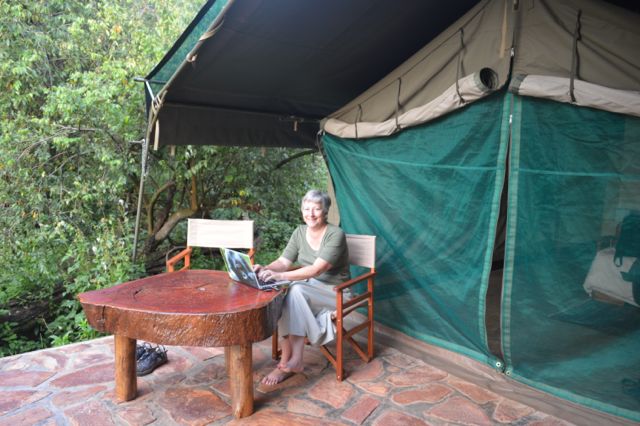
frontporchTent camps like Rusizi create jobs for local people and give guests a unique experience with wildlife and sense of place in the park. We found the tent cabin in which we stayed to be equal to and in some cases better than very nice ones in Kenya and Tanzania. The quality of food and service was exceptional with Ian, the lodge manager, and Eric, a server, caring for us thoughtfully. Our tent overlooked the water of Lake Ihema with hippos snorting in the shallows. The cabins and walkways are elevated so nightly visits by hippos moving onto land to graze are no threat to guests or hippos. The bathrooms have a tub, shower and two lavatories along with a flush toilet so creature comforts are as good as any five star hotel.

We left our tent flaps open all night with just the screens between us and the night music provided by nature, letting the light from the moon and stars shine through. When morning came we sat on our front porch awhile enjoying the antics of monkeys in the trees and then walked down to the waterfront restaurant to enjoy breakfast while looking at hippos and watching weaver finches build nests over the water.

roomWe will return to Akagera for the wildlife experience, and look forward to seeing the diversity and numbers of wildlife populations continue to increase and thrive. Ruzizi will be at the top of our list of places to stay. It is an amazing experience close to nature and comfortable beyond belief.

Rwanda’s national parks offer three unique experiences, the mountains and gorillas of Volcanoes, thirteen species of primates and an inordinate number of endemic bird species at Nyungwe, and savannah and wetlands wildlife at Akagera. Rwanda is definitely worth a visit for anyone who loves African wildlife, so we’re putting together a safari to all three of its national parks for later this year or early next year (with an extension to Serengeti for those who need lions and cheetahs). If you have an interest in supporting the efforts of this small, often overlooked country in developing its tourism capacity, consider joining us when we have the details worked out. We promise you won’t be disappointed.

– Tim Merriman

 P.S.  Our Akigera Photo Album is posted at http://www.facebook.com/HeartfeltAssociates.

Elephant Lessons

elefootThe quiet of elephants is one of the great mysteries of the animal kingdom. How can something so big move so softly, barely making a sound? I had the pleasure of spending some quality time with over one thousand elephants in the last few weeks in Tanzania, including two substantial groups of about 75 individuals each, one in Tarangire National Park and the other in Serengeti National Park. This is what I learned.

Community matters.

Watching elephants is a lesson in patience, family dynamics, sharing what you have, and taking care of others. Each elephant has a distinct personality that emerges the longer you watch and each of those personalities contributes to the social whole of the elephant

elefamcommunity. This bond between family members keeps young elephants safe as they venture beyond the reach of their mother’s watchful eyes. It ensures that everyone gets a turn at the water hole or mud bath. It means greeting each other thoughtfully after any separation, long or short. It is what keeps the herd vibrant and healthy, exploring other elephant communities, coming together, drifting apart, moving constantly in ordered disorder that makes seems to make perfect sense to the elephants as they go about their daily business.

Respect your elders.

The matriarchs know the rules and teach them to the younger elephants with gentle direction. They know where to go for the tastiest fruits, the tenderest grasses, the freshest water. And so the others follow because not to take advantage of that knowledge would be foolish. Certainly, younger elephants challenge the wisdom and experience of their elders – you can see it in their body language and their eyes. But as surely as they ask the questions, they accept the answers. The leaders never seem offended, but just continue to go about their daily business.

Walk gently in this world.

elegroupBeing the largest land mammal on the planet must surely have its drawbacks, but elephants wear that mantle with unparalleled grace. They seem to tiptoe through the brush, their entire bulk silently and suddenly appearing or disappearing from a landscape that seemed either devoid or full of elephants only a moment before.  Quiet rumblings of infrasound rarely detectable by the human ear keep them connected by a private language they are privileged to share. They use only what force and noise is necessary to protect themselves and their young, preferring to observe and indulge their insatiable curiosity with caution rather than participate in aggressive acts as they go about their daily business.

Elephants inspire me. We can all learn more about how to about our own daily business from watching them in the wild. It mystifies me that there are those who would wantonly slaughter elephants for their tusks, solely for financial gain. I cannot believe that those who demand ivory for ornaments understand exactly what the real cost has been. In fact, when questioned about where elephant ivory comes from, some purchasers have stated that they believe it is collected when the tusks fall out, like replaceable teeth. While it is true that elephants who stay in the heart of protected areas may be relatively safe, poaching of elephants ele2has not stopped. It has increased again in recent years and any elephant who ventures out of a protected area or remains on its fringes is at high risk in any African nation that still has elephants. Antipoaching efforts must include a variety of approaches to make a dent in the killing. Enactment and enforcement of antipoaching laws, rigorous conservation measures, and education of the public, poachers, sellers and buyers, must be braided strategies to keep from losing the remainder of these gentle giants in our own lifetime.

The African Wildlife Trust in Tanzania is working on all of these fronts in an effort to keep Tanzania’s elephant populations alive and well. Live elephants, aside from contributing to healthy ecosystems, help to keep the tourism economy functioning and employing local people. One of the current measures undertaken by AWT is to collar elephants in an effort to facilitate tracking of herds. The idea is that if a collared elephant, tracked by GPS, begins to panic and flee, a poaching incident is likely occurring, allowing the immediate dispatch of enforcement personnel to the site. Given that a recent slaughter in Cameroon involved the killing of 300 elephants in one incident because no one responded, there is real hope that collaring elephants may provide a useful tool in the fight against poaching. However, collars are expensive – one collar, which may last only three to five years, has a cost of $10,000 USD.

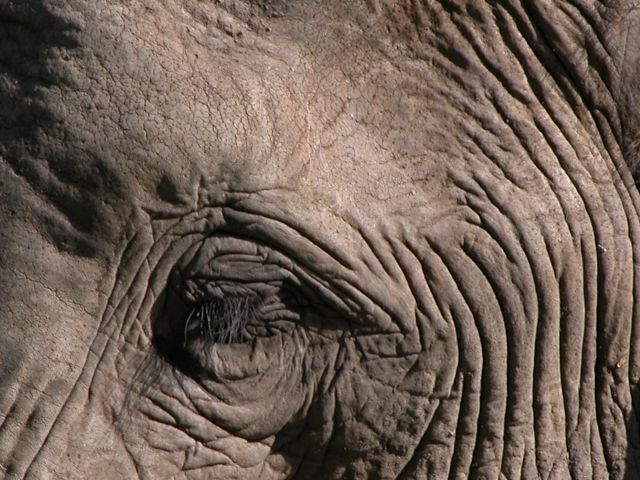
eleeyeI have set a personal goal of attempting to fund, with others, at least one collar a year for the next five years. I hope that you’ll help me with this effort as I certainly don’t have the funds to do this by myself. If $10,000 sounds like a lot of money, think about what you could reasonably give. If only 20 people would contribute $500 each, we could purchase our first collar. If you can only give $100, that helps. Working together, we may be able to make a real difference in a world that will continue to include elephants. Please contact me if you have any interest in helping with this effort.

In any case, I urge you to learn more about poaching and its effects on elephants, rhinos, and other animal populations. A simple google search turns up a wealth of articles but you can also keep an eye on dispatches from http://Africanwildlifetrust.org. If you need more inspiration, come with us to Tanzania and meet the elephants in person. Once they become your teachers, as they have become mine, you will surely become advocates on their behalf, even as you go about your daily business.

Lisa Brochu

Kikoti Camp, Tanzania; Glamping in Tarangire

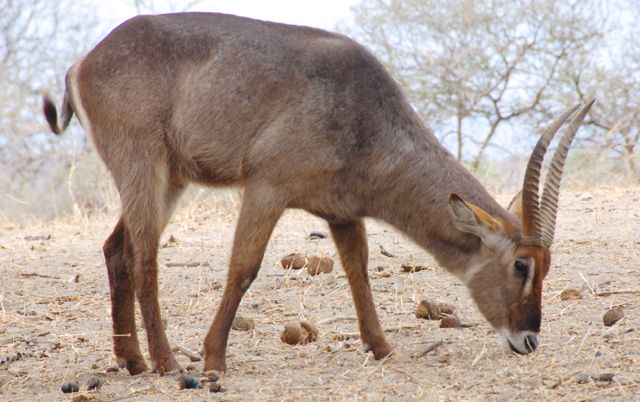
Male waterbuck near our tent.

At 3:30 AM one morning I awakened to the sounds of a waterbuck bellowing below our tent cabin in Kikoti Camp near Tarangire National Park in Tanzania. Kikoti is a wonderful combination of comfort and close to nature. Glamping, glamor camping, as some call it, is a wonderful experience and the Kikoti experience is first class.

We arrived at Kikoti after driving through Tarangire National Park, about an hour and a half out of Arusha. Tarangire is the land of tembo (elephants in Swahili) and

Tent cabin at Kikoti Lodge near Tarangire National Park.

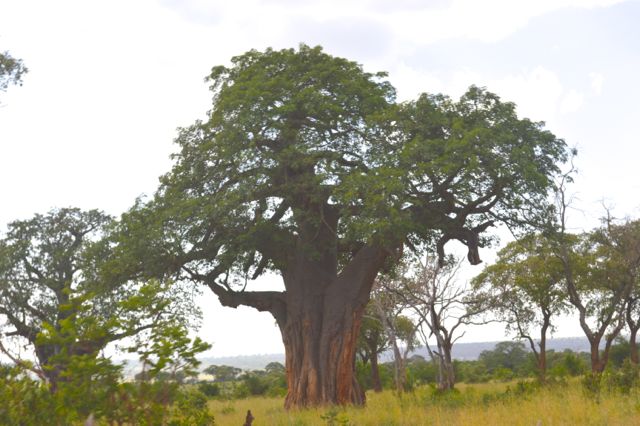
baobab, the upside down tree. The staff of Kikoti greeted us with a glass of fruit juice and a cold damp cloth to refresh us after our dusty journey. Alice, camp manager, quickly oriented us to safety practices and the camp schedule. Our first evening we showered quickly after our bags were delivered to our individual tents and settled around the campfire with Tusker beers in hand to enjoy a Maasai greeting dance.

Dinner soon followed with a tasty mix of meats and veggies in an open-sided dining room that looks out over the bush. Our journey through the park over the next couple of days gave us great safari memories with three leopards, four lions, a cheetah, hundreds of elephants, zebras, impala, waterbuck and beautiful birds that

Feisty young male elephants challenged us several times and then withdrew to safety with mom.

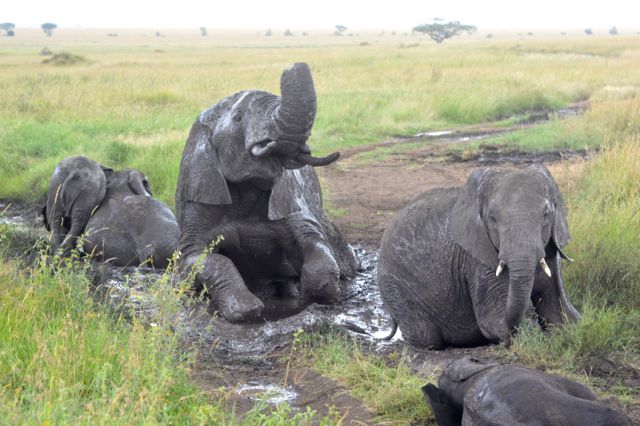
included rollers, hornbills, finches and more. We experienced our best elephant day ever in five trips to Africa with more than 1,000 pachyderms scattered along the road near the great swamp. They were taking mud baths, eating the lush seasonal grass and mating. Young males made fake charges a few feet toward us with ears fanned forward. None posed a serious threat as they were three to six years old, rushing towards us, then backing up as if to say, “Whoops, too big for me.” Once a protective mom heard her young boy bellow at us and she charged over to be sure he was safe. It was a wonderful day in all ways.

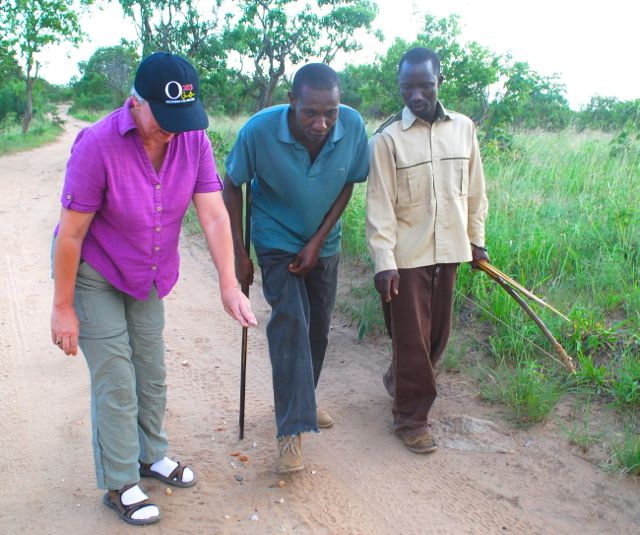
Lisa, David and Jacob (left to right) study tracks on our bushwalk near Kikoti.

That evening back at the camp we walked with Jacob, a bushman, David, a Meru tribesman, and a Maasai warrior carrying a gun. Jacob had his bow and four arrows, two laden with poison for more dangerous encounters. We walked two kilometers studying tracks and medicinal uses of trees interpreted by our guides. They grow up with nature, respect it, learn from it and willingly share their first-hand knowledge.

The tent cabins sit on large hardwood decks on stilts overlooking the park. Screened walls make it feel very open to breezes and sounds of wildlife. The bathroom behind the bedroom has a flush toilet, hot shower and two sinks, as good as any bathroom arrangement in a franchise hotel, except with much more local flavor in terms of the acacia wood trims and other small touches. A seating area and desk is included in the bedroom and an outside covered deck has two very comfy chairs with a table for morning coffee, which they bring when they give you a wake up call.

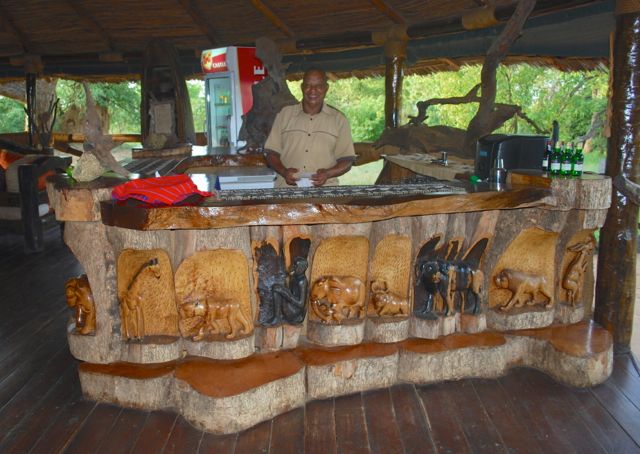
John tends bar, helps serve meals and generally makes old and new guests feel very welcome.

This fourth visit to Kikoti was shared with a group of friends and family. John, who tends bar and helps at meals remembers me from earlier visits so it feels like coming home to be here. The Maasai workers guide us back and forth from cabins in the evening to be sure we are safe from buffalo, waterbuck, and hyenas that routinely wander through the camp area. Gabriel, our skilled guide who traveled with us for ten days, told us of lion footprints found along the camp pathways while we were there. And that’s part of what makes a tent camp so charming. It’s built in wild places with very creative solutions for services. Many camps, Kikoti included, now get most of their electricity from solar panels, a step up from the generators of past times. They even have limited Internet access at the main office where you can recharge batteries and go online to check email.

When I was listening to waterbuck outside the tent early in the morning, I tried to remember the many African hotels, resorts and tent camps at which I have stayed. I can remember every single room, lodge and trail at the tent camps. The franchise lodges are a blur and I cannot remember their rooms. Tent camps create a richly

Stately baobabs, the upside-down tree, are common on the Tarangire landscape.

encoded experience in our brains because everything about them is singular, unique and usually thematically tied to the site. Our brains record those experiences in much greater complexity and we recall the places more easily. Tent camps are most definitely memory makers because they bring us closer to the outdoors and those sights, sounds, and smells that provide the backdrop for our brain recorders.

Wildlife sounds provided the music of the night as we stood on our front deck and marveled at the starlit sky with no area light interference, but the silence of the savannah is startling in its simple lack of people and machine noises. If you get to Tanzania, try to spend some quality time at Kikoti. It’s an experience not to be missed. -Tim Merriman

Five Good Reasons to Quit Lecturing and Start Learning

Scott Mair of Canada had a totally engaged audience as he portrayed Elvis the Elk as we shared interpretive training methods in Korea in 2006.
Many of us went to schools and colleges where lectures prevailed. The expert spoke from behind a lecturn while we tried to listen. I say try, because I, for one, often slept. I remember being in Dr. “Gabby” Galbreath’s Evolution classroom and awakening suddenly to laughter. I had dozed off and awakened to everyone watching me. He had a great sense of humor and a gruff voice. “Can I get you a pillow, Merriman? You look uncomfortable.” He laughed and went on. I never fell asleep in his class again, but I often wasn’t paying attention. It was not a requirement and even if it had been, I might not have been able to fulfill it.

Training others these past 18 years in the interpretive approach to communication and current brain research has driven me back to some very old principles and what I think are five good reasons to quit lecturing whether you are a classroom teacher or a non-formal interpreter.

1. You learn nothing if you lecture. Every audience or classroom has people who may share a thought or idea with you that improves your understanding of what you do. Sometimes it’s from the mouths of babes and sometimes from other professionals, but learning is good. Get it where you can.

2. A lecture does not encourage a conversation. People do not change their attitudes, beliefs and behaviors unless they think more deeply about what they believe. Conversations and thoughtful questions invite us to pay attention and start us thinking. Not everyone will join the conversation but in a lecture, few will engage.

3. Every audience or classroom is different. You do not adapt your lesson to the audience if you operate on assumptions. When you start the conversation, you find out what they believe. You can adapt.

4. Lecturing is boring for you and your audience. You repeat the presentation or lecture you’ve used before in the same old way. The passion in your voice will eventually sound like elevator music to the listener, something to ignore.

5. Addressing learning styles is not an academic exercise, but critical to success. Our knowledge of multiple learning styles or multiple intelligences suggest that auditory learning or even a combination of auditory and visual learning (Powerpoint) are rarely as engaging as interactive conversations with questions, demonstrations and activities whenever possible.

More than 2,000 years ago Socrates encouraged questioning in learning. His belief was intuitive, but it has proven to be a great approach. Social science research supports the power of bringing people to a greater understanding and voluntary behavior change through careful questioning, thematic presentations and multi-sensory approaches.

And yet I still see lectures in both formal settings such as classrooms and conferences and in nonformal interpretive settings. We can do better. Let’s lay down our crutches of Powerpoint and lecterns and be more creative, for ourselves and for our audiences.

-Tim Merriman

Rwandan Guides Share Nyungwe’s Beauty with Guests

Nyungwe National Park in the distance is surrounded by tea fields and eucalyptus groves that support local cultural communities.

Nyungwe National Park is nestled in the southwest corner of Rwanda, a nation roughly the size of the state of Maryland. Nyungwe is several hours south of Volcanoes National Park (VNP) of “Gorillas in the Mist” fame. VNP brings people from all over the world to northern Rwanda, but some manage to also find this emerald forest in Nyungwe by Lake Kivu.

We first visited Rwanda in October 2012 at the request of USAID. Our assessment of the visitor experience and park guides’ skills led to this USAID supported trip to conduct NAI’s Certified Interpretive Guide (CIG) course for thirty guides in two class groups and the Certified Interpretive Host (CIH) course for individuals from seven partner organizations within and around the park, including community cultural programs, lodges, and World Conservation Society (WCS) along with Nyungwe’s chief wardens and reception personnel.

We completed the first CIG course on January 24th and I think we enjoyed the five days as much as the guides and learned much from them. We added a day to the usual four-day training in recognition of the language and cultural challenges and we probably could have used several more. All of Nyungwe’s guides speak English well, but Kinyarwanda and French are the preferred languages of several of them.

CIG Class at Nyungwe National Park Jan. 2013.

The guides performed admirably and thirteen earned the CIG credential in the first course. They know the birds, trees, and primates of this incredible landscape quite well, but the social science and communication techniques of the CIG course were mostly new to them and they took to the requirements eagerly. We saw incredible examples of thought-provoking thematic presentations in the 10-minute performance portion of the course. They are rightfully proud of having earned the credentials.

As we said goodbye to what we know will be new lifelong friends, we turned our attention to a day of regrouping before tackling the CIHost course. We spent part of our day off with Hope (Espoir), one of our CIG students, who took us for a short

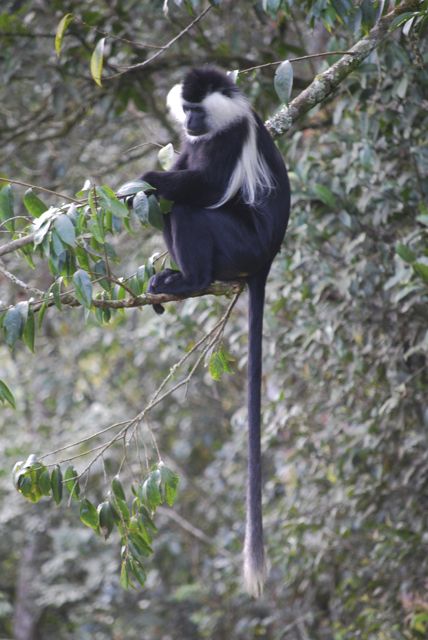
Angolan Colobus monkeys live in large family groups in this tropical rainforest.

walk in the tea fields near Gisakura at the edge of the rainforest. We were met near Nyungwe Forest Lodge by a woman tracker, who took us up close to a troop of 45 Angolan colobus monkeys. For two hours we watched them as they moved closer and closer to us out of curiosity, until they were only about ten to twenty feet away. Then the tracker urged us to move back toward the tea fields where she had spotted a Mona monkey, one of the thirteen species of primates in Nyungwe we had not yet seen. The Mona had a beautiful expressive face and brought our total to nine species of primates viewed in this remarkable forest. We took about 1100 photos and video clips through the magic of Nikon 3200 and D40 cameras, including colobus monkeys jumping from tree to tree and interacting with mountain monkeys that entered their feeding area. It was amazing and Hope’s interpretation of it all was heartwarming. He brings just the right blend of stories, time to observe, questions and personal enthusiasm to the conversation.

This single Mona monkey travels with 45 Angolan Colobus as an accepted companion.

It turned out to be one of the best days I have ever enjoyed in the outdoors. As we walked with Hope back to the reception office, we were simply overwhelmed by the experience. It started to rain just as we approached the Gisakura Guest House, where a cup of hot coffee and a delicious lunch was waiting. We have been profoundly touched by these hospitable people and the rich landscape where they work.

Nyungwe is two and a half hours from Kigali, the capital of Rwanda, and only a few miles from Democratic Republic of the Congo and Burundi. It boasts thirteen species of primates including chimpanzees, 1016 species of plants, 278 species of birds and dozens of endemics (found only here). It is a naturalist’s paradise, but it is much more than that.  Its mission statement reflects its global and regional significance and emphasizes a balance between conservation and tourism. Here, you can stay at beautifully located lodges surrounding the park, walk the trails with well-trained guides and relax with the amazing hospitality of the Rwandan people.

The painful civil conflict of almost two decades ago is not forgotten but peace and reconciliation have been the practice of this nation in recovering. It is a safe place to visit and Nyungwe provides incredible trails, waterfalls, dense montane rainforest, rich wildlife and unique cultural experiences.

 Mountain gorillas are the attraction in Volcanoes National Park in northern Rwanda.
Mountain gorillas are the attraction in Volcanoes National Park in northern Rwanda.

They have protected and interpret more than 1,010 square kilometers of pristine rainforest for the future of their children and all mankind. This preserve protects more than 70% of the water used by the people of Rwanda and the headwaters of both the Congo and Nile Rivers, relied upon by hundreds of villages. Once threatened by poaching, gold mining and the burning of bee trees, the forest is now carefully managed to protect the biodiversity of the region and support local communities.

Rwanda’s gorilla tracking in the Virunga Volcanoes should be a bucket list trip for everyone in our opinion, but Nyungwe has much to offer also. If you get a chance to visit this friendly nation, do not miss Nyungwe National Park. You will be met by talented and dedicated guides, who will be happy to share their forest with you.

–Tim Merriman

Beware the Memorized Spiel

I once attended a guided tour of a large, expensive visitor center for a major religious group in the United States. Elders of the church met people at the door of the center to offer a free, guided tour. I joined a tour and our group obediently followed the guide as he delivered what was clearly a memorized spiel. After twenty minutes on the very boring tour, I asked him a question. He glared at me, did not answer the question and explained to the group that he had lost his place and we would have to start over. Now my entire group glared at me, warning with their eyes – “no more questions.”


I have been asked many times by managers why it would not be preferable to develop a really high quality tour or presentation and require guides or interpreters to deliver it word for word. That may seem efficient and effective, but is it? I think it’s easy to make a case against it for the following reasons:


  1. A canned spiel shows no respect for the audience. You are presuming that one size fits all. You are not adapting to each unique audience to make it more interesting. You are certainly not being an interpreter because the interpretive profession is built on knowledge of and adaptation to each unique audience. Will a group of visiting scientists enjoy and understand the same program as a group of high school students?
  2. Where’s the passion? It takes an amazing actor to give the same presentation over and over in the same words and sound enthusiastic. Memorized presentations usually sound incredibly wooden, lacking the authentic passion and voice of the presenter.
  3. Will it be sustainable? Most places that give guided tours “burn out” their guides to some degree. Burn out is faster when the guide has no free will in what is said. Memorization requires being faithful to the script instead of the audience and results in the problem my guide had with losing his place and having to start over.
  4. Questions are usually not welcomed from the audience or appropriately used by the guide in a memorized presentation. If you ask only rhetorical questions with no expectation of a real conversation, people soon tune out and may simply leave. If you do not allow your audience to ask questions, you are less likely to provoke any further thought or action about your subject that will help you accomplish objectives.


Training guides and docents to respond flexibly and present thematically will yield a more sustainable result in virtually every situation. Guides and interpreters enjoy their work and stay with it longer when they are respected for their abilities. Giving information in a rehearsed format has proven to be much less effective in helping people connect to a resource than engaging in a good conversation as part of a thematic tour.


If you need assistance training guides or interpretive staff, let us know.  We will be happy to help. It’s an investment well worth making.


– Tim Merriman


A Motivation by Any Other Name

I have questions about visitors, clients and customers. Who are they? What do they want to do? What do they enjoy? What kinds of experiences appeal to them? Is it enough to know their age group or their family status?

My grandson, Tim, explores the jumping dance with the Maasai.

Many planners have spent many decades developing visitor experiences with market segmentation approaches that are easy to understand but do not really inform the planning process. Classifying people as seniors, empty nesters, families, yuppies, tweeners, and the like will give some general information about them. It does not necessarily suggest what interests them, or what types of experiences they prefer.

In recent planning workshops, we’ve been introducing participants to the Why Zoos and Aquariums Matter study by John H. Falk, Eric M. Reinhard, Cynthia L. Vernon et al. This report uses motivations to determine market segments at interpretive sites. Although it’s certainly not the only way to look at market segmentation, and not the only one we use for every project, this is one approach that might useful in thinking about facilities and programs being planned for some situations. The segments, in the researchers’ words, are as follows.

Explorers” are curiosity-driven and seek to learn more about whatever they might encounter at the institution – might spend more time and get more involved – potential volunteers often come from this group.


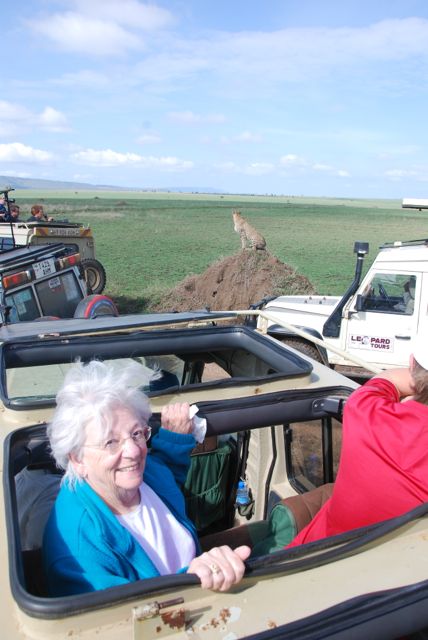
Lisa shares the Serengeti experience with Lou, her mom.

Facilitators” are focused primarily on sharing the experience with others – parents and grandparents bringing children, locals bringing friends from out of town.


Professional/Hobbyists” feel a close tie between the institution’s content and their professional or hobbyist passions – might enjoy going “behind the scenes”.


Experience Seekers” get satisfaction from the fact of visiting this important site – often want a photo taken of the guest with the resource behind her or him.


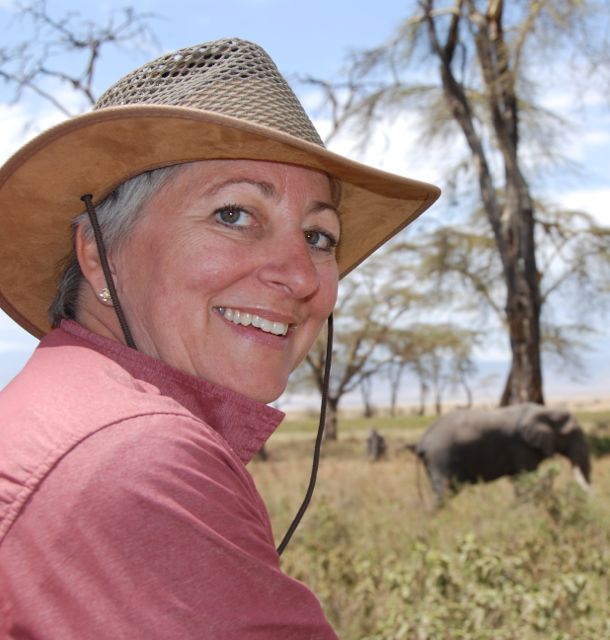
Lisa enjoys the "sensualist" or "recharger" time in Ngorogoro Crater with an old bull elephant.
Lisa enjoys the “sensualist” or “recharger” time in Ngorogoro Crater with an old bull elephant.

Spiritual Rechargers” seek a contemplative and/or restorative experience – may want to just sit or walk and enjoy without interpretive signs or messages.

Susan Cross, a very experienced planner in the United Kingdom, shares her thoughts on segmentation in TellTale, her planning blog’s article, “A simple, successful approach to visitor segmentation at heritage attractions.” Susan credits the research behind the approach to Morris Hargreaves McIntyre – Lateral Thinkers, a cultural heritage consultancy group that suggests using a motive-based segmentation approach with categories similar to that suggested by Falk’s zoo study.

Sensualists seek emotional and spiritual rewards – For Sensualists ‘just being there‘ is enough. ‘Taking in the view‘, ‘becoming one with the past‘,’ finding peace and harmony in nature‘, ‘experiencing beauty’, ‘finding inspiration‘ are the rewards these people want from their visit.

Intellectuals want to find out more. They hear or do things that relate to their interest and probably talk to people who share their interest and can answer their questions. Intellectual Visitors want to pursue an interest. They may be novices or experts but they are interested.  They wish to learn more, increase their knowledge, improve their skills, see, hear or do things that relate to their interest and probably talk to people who share their interest and can answer their questions.

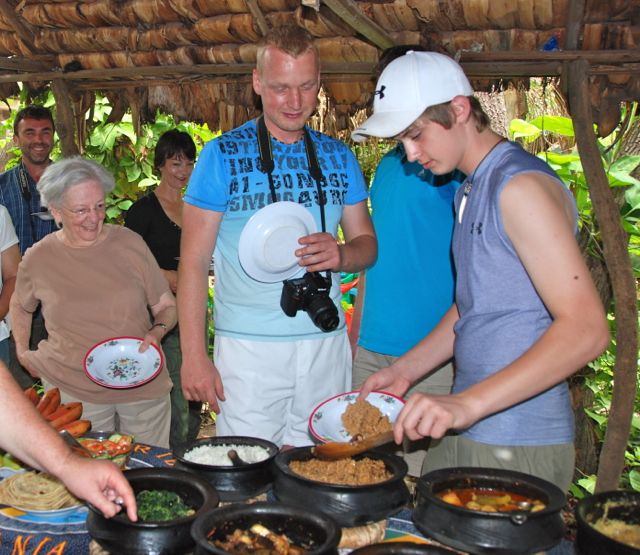
Mealtimes are great social times to get to know fellow travelers from Czech Republic.

Social Visitors are building relationships and want to spend enjoyable time with family and friends in a pleasant and interesting environment. They like sharing experiences, talking to each other, finding new things to talk about, conversations with other people, and good visitor facilities.

Exploring Families are adults visiting with children. They too want to spend quality time together. It important that this includes shared activity and some discovery and learning.

If you were to correlate the categories across the two approaches, you might find that “intellectuals” seem similar to “professional/hobbyists.” “Sensualists” seem similar to “spiritual rechargers.” “Exploring families” seem to include the “facilitators.” “Social visitors” remind us of the “experience seekers,” although Falk’s study mentions that the social aspect of the visit may be secondary to having the experience. The in depth “Explorer” motivation in the zoo study is not in the four categories of the British segmentation. I still like it to describe that person who will take the behind the scenes tour, sign up to visit a paleontological dig or become that devoted volunteer.

Experience seekers want those special photos that remind them of the unique place and time.

We led an ecotour to Tanzania in 2010 and we were examples of all of the categories at various times. Some times we were “experience seekers” or “social visitors” just taking a quick look at the Oldupai Museum where we took photos of ourselves with the exhibit that showed the original trackway that so intrigued the Leakeys, or sat around the campfire sharing stories from earlier that day with fellow travelers. We had brought Lisa’s mom (age 81) and my grandson (age 14) along to share the experience, and so we could very often be considered “exploring families” or “facilitators” since we had taken this trip once before and were eager to provide tips to enhance their enjoyment. We became the “professional/hobbyists” or “intellectuals” when chatting with facility managers or biologists along the way. Certainly, everyone on this kind of safari in the Serengeti is an “explorer.” It is expensive and has some elements of danger so those without the explorer interest are more likely to catch it on the Nat Geo TV show of the same name from the safety of their armchairs. When time permitted, we turned into “sensualists” or “spiritual rechargers.” It was great to sit for two hours by the hippo pool and just enjoy their unique social interactions, sounds, and smells. No explanation was necessary to be completely engaged by the zen of hippo watching.

I tell this story of our Tanzania tour to make the point that no matter which nomenclature you choose to use, people don’t always fit into neat categories. One person may be one type of visitor with certain interests or motivations in one setting, while having completely different interests or motivations in another. Similarly, groups of people probably have a blend of these category types within the group at any given time. Hippo watching recharges some people, while others become bored and drift away from the group to engage in a different conversation or activity.

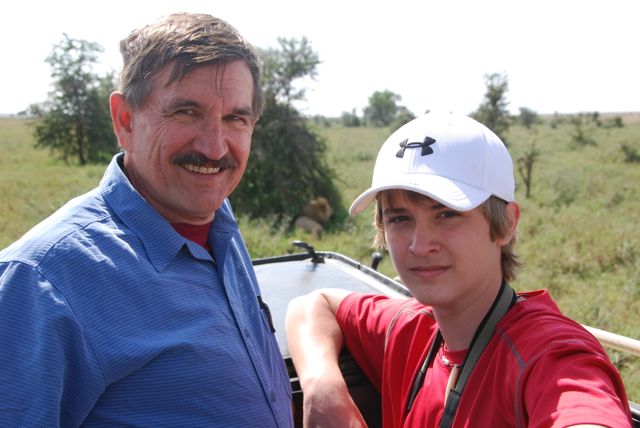
Tim and Tim, grandfather and grandson with a lion in background, a memory for both of us we will not forget.

As a planner, thinking about motivations of a visitor allows you to think about visitor experience design with these motivations in mind. Some places are just beautiful enough that they need no interpretive signs to make them better. In fact, the sensualists or rechargers will like it better if such places remain uncluttered with media. That behind the scenes tour may attract explorers or intellectuals to learn more. We can even design places for the “experience seeker” or “exploring family” to have their picture taken with a great cultural artifact or giant clamshell. It is often more challenging to design a compelling experience for a 50 to 60 year old African American female from a city who makes $65,000 a year. We usually find that some combination of geographic, demographic, and psychographic information in a market analysis provides better information with which to make informed decisions about the proposed experiences. But each planning situation is a little different and which market segmentation approach is most appropriate for which situation will depend on a variety of factors.

Whether these two segmentation approaches represent convergent evolution in planning or a situation of having read each other’s studies, the fact that both have emerged as planning tools is a good thing. Our guests do not represent only age groups or economic groups. They are real people with interests that may change even in the middle of an experience. And if we’re paying attention, we can plan ahead to accommodate that.

– Tim Merriman

Collaborate, Leverage, Partner and Package

41eulYJlfoL._AA160_When I lived and worked in Pueblo, Colorado, as a nature center director I had the opportunity to participate in a community collaborative planning group that really produced for all of us. I have written about it before in blogs and in our book, Put the HEART Back In Your Community.

Too often collaboration is driven by one government agency or organization. Sometimes it is a mandated process to involve others. Often that does not really feel like collaboration. It feels more like, “They wanted to say they had listened to stakeholders, but they don’t really care.” True collaboration among stakeholders has a very democratic feeling about it. In Pueblo, representatives of diverse interests met monthly to share ideas, leverage grants, plan joint projects and provide support for any applications made. It resulted over many years in creation of the Historic Arkansas Riverwalk of Pueblo (HARP).

In 1993, I worked for Tennessee Valley Authority at Land Between the Lakes (LBL) National Recreation Area as Manager of Research and Innovations. Managing the Biosphere Reserve (BR) Program was part of my duties and that included the creation of a BR Cooperative with social, environmental and economic stakeholders. We convened meetings regularly and I quickly heard the suspicion of other stakeholders that TVA would dominate the agenda. They were very used to government control and collaboration sounded like a ruse. It was not, but the dynamics of change soon led to LBL being transferred to the U.S. Forest Service and the cooperative collapsed before accomplishing anything.

Historic Arkansas Riverwalk in Pueblo, CO.

I think collaborative planning works best when you see it as an opportunity to build a stronger organization or community with no agenda of control. You can be a catalyst for getting the key stakeholders together just by hosting a breakfast or lunch once a month. As soon as you exert CONTROL in some way, you are likely to lose the people who might otherwise participate.

Any time you submit a grant or proposal for funding with half a dozen or more organizations working together, you are more likely to be funded. When a grant requires matching funds, one partner may have access to money while another provides technical skills, such as GIS maps or landscape architectural drawings. As a nonprofit nature center director, I ended up being the grant writer for our group.

In Pueblo we did not include the for-profit participants that would have brought even greater strength to the table. We had city, county, and state governments and multiple nonprofits involved but could and probably should have invited the Chamber of Commerce and economic development interests that had their own collaborative groups.

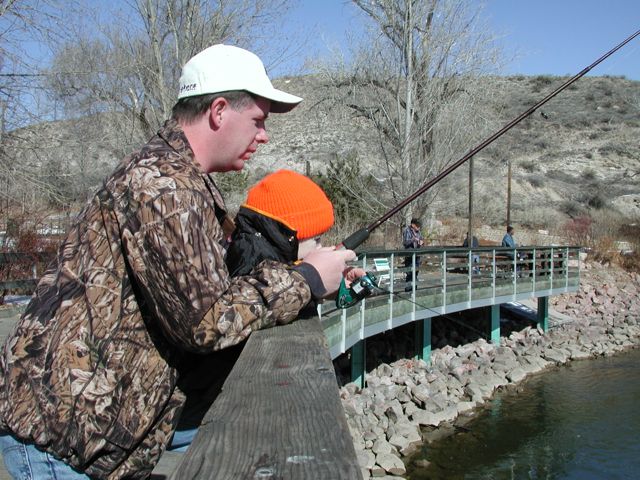
This fishing dock at the Pueblo Nature Center was funded by a grant developed by the collaborative planning group.

One of the great benefits of a collaborative effort is the opportunity to develop partnerships and package services together to create more holistic experiences. Lodging, food, transportation and attractions like zoos, museums, aquariums and nature centers can create experiences that might appeal to visitors more than figuring out the logistics piece-meal.

A collaborative planning group could also work on a collaborative interpretive plan that unites the community or multiple partners behind a central message and community experiences. Too often we work alone when we could be working together with community stakeholders who might all gain from working together.

Some group or individual has to be the catalyst. Invite your logical collaborators to a meal and meeting. Bring them together around a chance to work on a challenge or grant together. Success in this effort is intoxicating. Once you land money or do a project together, you will most certainly want to do more.

-Tim Merriman

Mto wa Mbu, A Great Cultural Tour in Tanzania

mto5February 5 to 16, 2013, we’ll be in Tanzania to host a photo safari/ecotour with World Discovery Safaris and Safari Legacy. One of my favorite stops on this particular itinerary is Mto wa Mbu, near the entrance to Lake Manyara National Park.

Mto wa Mbu (which translates to Mosquito River) is a community in central Tanzania with a unique Cultural Tourism Programme. This agricultural community includes representatives from more than 120 tribes who moved into the area to take advantage of the opportunities provided by an irrigation project in the 1950s. In 1995, SNV – The Netherlands Dutch Development Organisation assisted the Tanzania Tourism Board in developing programs to provide benefits to local people. The community was involved in planning the tours to be offered and they manage the tours.

On a previous tour of Tanzania, we took part in one of these tours and found a well-designed experience that began with a slow meander through the community marketplace where local women sit at wooden tables heaped with dried fish, fresh fruits, vegetables, chickens, eggs, clothing and household goods.

mto2Next we visited the home of a Chaga family who brews banana beer. There we learned the unique story of how this special brew is key in marriage negotiations and friendships. It is 1 to 2% alcohol and must be drunk “green” when it is one to two days old, because it goes bad quickly. We passed a mug of beer to share among our fellow travelers and the pleasant taste was unique, unlike any beer I’ve ever tasted.

We then walked to an open-air shop where our guide explained that woodcarvers are taught to create three-dimensional pieces that represent people from different tribes working and living together in harmony. The effort required by these complex carvings helps the craftsmen to hone their skills before carving simpler items offered in most sales outlets. Visitors can purchase the work direct from the woodcarvers working on site if desired. We also visited a cooperative where local artists demonstrated the traditional Tinga Tinga style of painting. Finally, our guide led us down a trail through a banana farm to learn about the many varieties grown for beer brewing, eating, and cooking as vegetables.

The tour of the farm ended in an outdoor shelter with local women preparing traditional dishes over open fires. When the food was ready mto1they interpreted each food dish before we served ourselves buffet style. We had white rice, brown rice with beef, okra, spinach, spicy beef in oil, eggplant, potatoes with cardamom and cinnamon, and pork ribs. The food was delicious, washed down with a cold soft drink or the local Tusker beer.

Our upcoming tour will allow us to visit at least three cultural communities and five national parks and conservation areas. We have just a few seats left for this tour at the height of the wildlife migration season in the Serengeti. If you have the time, desire and funds to take part, please join us for the trip of a lifetime.


Download the Tanzania Tour PDF Itinerary – Feb. 2013 12-Day Tanzania Safari – Questions – 970-231-0537 or tim@heartfeltassociates.com

– Tim Merriman