Five Ideas to Engage Your Audience

When I have the opportunity to speak to a group, my challenge is to find the most bored and tuned out person sitting in the audience and get him or her more fully engaged with whatever subject matter I’m presenting. Given that I’m usually trying to influence audience members to move toward greater stewardship of natural and cultural resources or understand science

Scott Mair of Victoria, Canada, is the master of audience engagement. This program in Korea combined the arts with weather interpretation.
Scott Mair of Victoria, Canada, is the master of audience engagement. This program in Korea combined the arts with weather interpretation and involved the audience in singing about clouds.

and research and value a thoughtful approach to decision making in the world, I believe it’s important that they pay attention and leave thinking about what they’ve heard.

Research tells us that getting people to think is the key to influencing their behavior in positive ways. If you want them to think, you have to get their attention, hold it and start a conversation. Here are five ways to do that:


  1. Get Organized – If you cannot hold their attention, it will not matter that you have a powerful message. Advance organizers, like a title with a hook, get people to show up with a good attitude and the expectation that they will hear something of interest. Introducing the theme of your talk in the introduction, developing it in the body and restating it in the conclusion is a powerful approach to getting and holding attention if your theme is strong.
  2. Relate to Audience Interests – You must relate to each person in your audience in a way that matters to them. Weaving both the tangible elements of your talk (things that can be seen, touched, smelled, heard or experienced with the senses) with the intangibles (concepts, ideas) will ground people with things familiar to them and lead them to the less familiar ideas you wish to introduce. Universal intangibles such as family, life, death, love and fear are more powerful in engaging people than jargon that will be understood only by a few in the audience. For example I could say, “Every cell in my body has the exact blueprints for another ‘me’ stored and everyone in my family has a similar set of blueprints
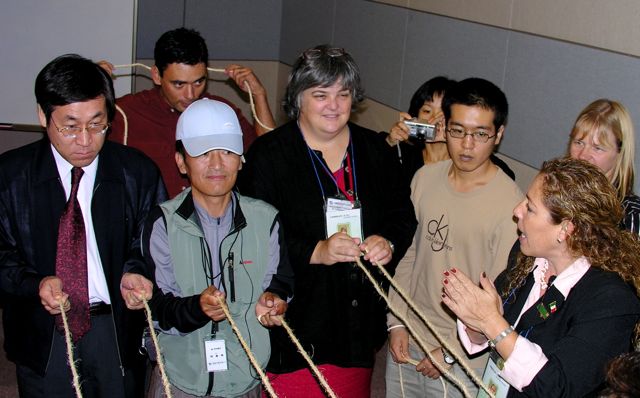
    Maria Elena Muriel had her non-English speaking audience totally enthralled as she invited the audience to build the warp of a loom from ropes to weave a giant fabric.
    Maria Elena Muriel of Mexico had her non-English speaking audience in Korea totally enthralled as she invited the audience to build the warp of a loom from ropes to weave a giant fabric.

    to mine resulting in our family resemblances, like big ears.” Or I could say, “The 46 chromosomes in the nucleus of each cell in my body contains a pattern of nucleotides that permit the exact replication of my physical/physiological structure and each member of my family have a similar chromosomal pattern to mine with minor variations related to their specific genotype and phenotype.” Unless I’m talking with other scientists, the first version is more likely to be something the audience will be interested in and understand.

  3. Be interesting – People are more likely to stay engaged if they are having an emotional reaction as well as intellectual stimulation. It doesn’t mean the subject and theme must be light and comedic. “How can each of us help prevent our children from being bullied?” That sounds like a heavy subject and hook, but any parent might have an emotional reaction to that discussion because it will answer some concerns they have about their children in school. Museums of Social Conscience like The Holocaust Museum take on challenging subjects and engage their audience, knowing that many people will come to a greater understanding of human tragedies and challenges through the emotional experience. Being entertainingworks with some audiences, but being interesting by stimulating both emotional and intellectual connections will keep your audience engaged.
  4. Ask Questions – When you ask your audience a question and allow them to answer, you start a conversation that is more personal than simply delivering information. By starting with an open question, you assure the listeners that you want to hear them and no answer is wrong. When you follow with a focusing question, you point them toward your message and invite them to think about your idea. Then you might ask an interpretive or processing question, which invites them to use their knowledge to come to some new conclusion. Last is the application or capstone question that leaves them with something to think about. “How might our climate be different, if we began using solar energy instead of fossil fuels to power the planet?” Socrates taught his students through questioning two millennia ago and it still works in getting audience engagement. Asking questions is one of the best ways to get people to think and pay attention.
  5. Encourage Participation – It can be as simple as asking an audience questions and having them give feedback by holding up hands or standing up. “How many of you can find Orion in the night sky easily?” That works even with a very large audience. Or you might try an activity with smaller groups to get everyone on their feet doing something. Bringing just a few audience members on stage to demonstrate something adds interest as their friends and colleagues will enjoy seeing them take part.
These are just a few ideas for engaging an audience to get them to think more deeply about your subject matter and message. You might enjoy hearing yourself talk, but your audience will stay with you longer if you keep their interests in the forefront. And I may not engage that fella on the back row who fell asleep, but I’ll keep trying.

-Tim Merriman

Five Ways to Build a Strong Membership

Twice in my career I have run membership organizations. In each case building membership was important to our work. And I learned a lot about that from others who had been building membership successfully for years.

These are five of the better tactics for building and retaining a strong and lasting membership in my experience:

A membership table manned by member volunteers works well at the entrance on high volume days (Dallas Arboretum).

Personal Selling: Everyone at the organization can be trained to invite people to become members. They have to know the benefits and accurately explain them. I’ll never forget receiving a business card from a colleague that had a brief membership form printed on the back. He considered every card he handed out a chance to get a member. Ask people to join every time you give a talk to a civic organization and track the percentage of your audience that joins.

Free Memberships: Give a membership to anyone who attends one of your special events, conferences, seminars or webinars. If you charge non-members more (as you should), make the amount equal to a year of membership so that they see your services for a year and hopefully stay part of the family.

Invite People to Join at Entry: If you have a gate fee or entry fee to property, start with “Members get in free year-round. Would you like to join today and get in free now and for the coming year?”

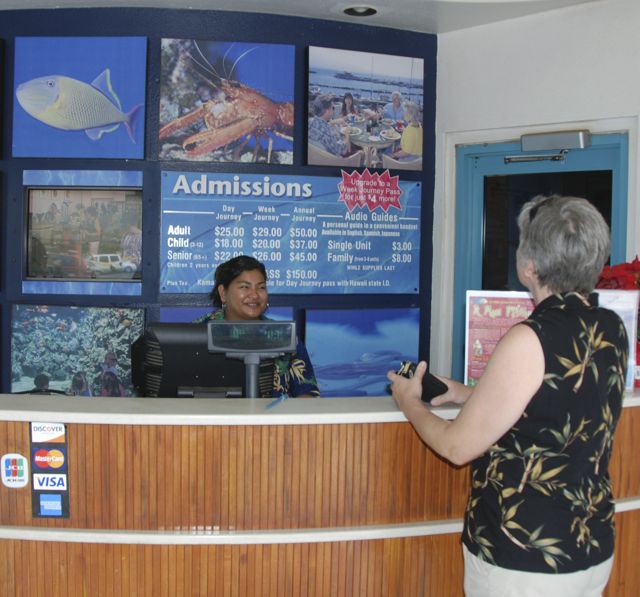
Showing the membership as an annual pass also works at entry (Maui Ocean Center).

Give Away a Trial Membership: Many organizations have found that asking folks to sign up that first time is the challenge. I once added a fee for use of picnic grounds at a nature center and to soften the blow of the change, we gave everyone who came out to picnic a free membership for that first year of change. It built goodwill and many later renewed on their own.

Offer Auto Renewal: If you give people the option of renewing automatically, many will take it. When that annual reminder comes, some people simply miss it or don’t get around to sending a check. Plan it so they can stay in your network as long as they wish without extra effort.

Membership may or may not be a large revenue source to support other activities. Often you must spend as much as you take in to provide benefits to members. However, they are also giving you money in annual campaigns, capital campaigns and as bequests in their estates. They are selling your organization to friends. They are your advocates when political problems arise. And some of them will emerge as major donors of long-term importance or volunteers.

They are your warm market, your family. Recognize them by name when you write about programs, recognize their gifts publicly on the Internet, in physical locations and with permanent markers when it makes sense for the size of their gifts.

There are many more ways to grow your membership but these five key approaches can get you started.

-Tim Merriman

Learning from Failure

I once had a government job as a manager with a small direct-report staff and responsibilities for training more than 200 employees. I was called into my supervisor’s office and asked to stop talking about mistakes I had made and failed business efforts. I was destroying employee confidence in me it seemed. Our corporate culture valued appearances more than honesty and learning from failures.

I always hope organizations will value honesty and courage in pursuit of success while analyzing failures.

A number of very successful business people have failed one or more times in their careers, notably Walt Disney. He had a bankruptcy early on but seemed to do pretty well later in life.

I don’t think we learn much from success in most cases. If we make a good guess about a business or new program and it all works out, we just think we are brilliant. If we have a program or business enterprise fail, we have to readjust, do things differently. Hopefully we analyze why the idea was not so good and learn from it so that we can apply what we’ve learned as we plan our next venture.

In April of 2011 Amy Edmondon wrote in Harvard Business Review about Strategies for Learning from Failure, saying “the unfortunate consequence is that many failures go unreported and their lessons are lost.”

Corporate cultures that embrace failure as an opportunity to learn often have very high standards for performance. I’m reminded that restaurants that ask at each meal how the food and service was are usually the ones that don’t need to ask.  They value honest feedback and use it to continuously improve.

Some of the best research and development organizations actually have protocols for analysis of failures because they expect many approaches to fail. They’re looking for the few successful approaches hidden within.

Cultures that cast blame and discourage open discussion of failures run the risk of seeming trouble-free when they actually harbor deep systemic problems. When we simply cast blame after failures, we are powerless. Someone else screwed up. Taking personal responsibility to have honest discussions, analyze what did not work, and enlist everyone in making improvements has hope of getting results.

Many organizations have a core value about honesty. That plays out in myriad ways, including the embrace of failures as another chance to learn and improve.

– Tim Merriman, Ph.D.

Let’s Get Personal

Every time I go in my bank I expect to hear one of the clerks I’ve seen many times to call me by name. It never happens. I am in there every week or two and have been using this bank for 15 years. They are consistent. No one, even if they’ve seen me a dozen times in recent months, knows my name or remembers anything about me. They do ask me questions about our business and what we do for a living, but they don’t remember a week later or connect the story with me.

Yes, I live in a college town with lots of staff turnover. Bank tellers see a lot of people in a day. But the lady that cuts my hair every six to twelve weeks remembers me and chats about what I’ve been doing lately, starting from where our conversation left off the time before. She bothers to remember regular customers. What’s the difference?

This simple nametag invites  guests to chat with Nancy and her smile is welcoming at Longwood Gardens in Philadelphia.
This simple nametag invites guests to chat with Nancy and her smile is welcoming at Longwood Gardens in Philadelphia.

Many of your employees or colleagues will only see a guest one time for a few moments. I don’t expect the personalization there, but if you run an organization with memberships and repeat visitors, be assured they will notice whether you remember them or not. Most membership software can be customized to differentiate between legal names and the nickname a member prefers or the title, if they wish to be addressed as Doctor or Reverend. Some software allows you to make additional notes about family members and preferences.

You have an opportunity to get personal every single day you meet customers, clients and members. You can find out who they are and what interests they have. You can share your own personal story, your passion about what you do for a living.  You can have that conversation that both you and your guest will remember. In a community where people come back regularly to places they enjoy, relationships grow and become more important when customers are treated less like customers and more like extended family.

So how do you encourage your staff to get more personal without being intrusive? I like nametags with first names and the city or state where the worker grew up. At a park, zoo, museum or resort that location can be a real conversation starter and many concessionaires and resort operators use this technique. I see “Illinois” on a tag and I explain I grew up there. We are off and talking. It is a starting place. But a name tag with a last name or “Officer Jones” is off-putting. It is a way of saying, “keep your distance.” Worse yet, no nametag at all makes it hard for guests to know who works at the site and whether it’s okay to ask questions or start a conversation.

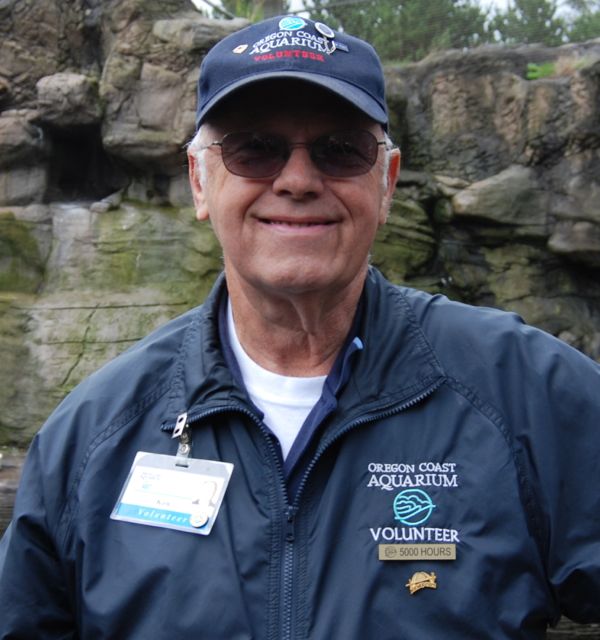
I like it that this docent at an aquarium has a name tag and clear ID as a volunteer.
I like it that this docent at an aquarium has a name tag and clear ID as a volunteer. It also recognizes that he has put in more than 500 hours.

When you are going to spend all day or multiple days touring with a specific group of people who have just met, name tags for everyone makes it easier for the group members to get to know each other. I’m not suggesting you should always use first names. Some cultures (Chinese, for example) usually say Mr. or Ms. ________ as a usual protocol and prefer that. Some older Americans expect to be addressed more formally. But you can always ask for preferences or allow people to fill out a nametag by hand with how they wished to be addressed. They may actually prefer a nickname. If you solicit information for a tour because you will prepare nametags in advance, ask how they wish to be addressed. Do not assume. I’ve been Timothy my whole life due to a birth certificate, and I’m automatically irritated if called that. It tells me the person addressing me is looking at a legal identification and does not want to be more personal.

You can train your staff to be skilled in this area and help them build more lasting relationships with guests. And if your customers or members are from other nations or communities, training in cultural competency has great value.  You never get a second chance to make a first impression, so starting the conversation well matters.

And if I ever have the good luck to meet you in person, please, call me Tim.

– Tim Merriman

Not all those who wander are lost . . .*

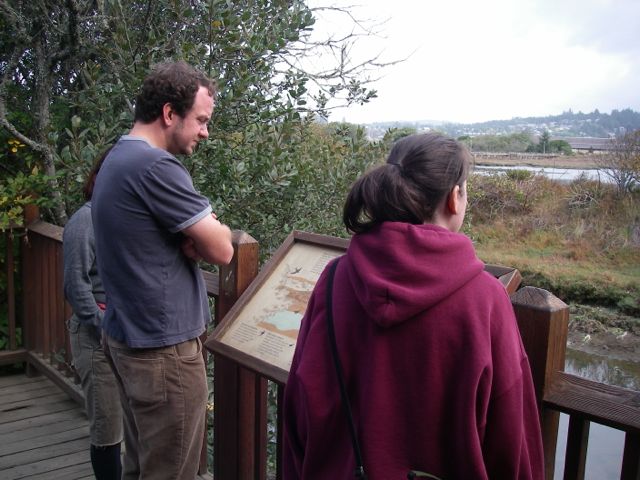
Sometimes it is helpful to watch guests looking at signs or exhibits.

Phil Hewlett and David Packard of HP fame suggested that “management by walking around” is an extraordinarily useful tool for seeing how operations are going in the workplace. Just getting out and seeing how your employees are working and interacting with each other can tell you far more than staying in your office and only observing reactions to question and answer sessions during annual evaluations.

I’ve found that same principle to be valuable in interpretive planning. In fact, it’s my second principle of interpretive planning from Interpretive Planning: the 5-M Model for Successful Planning Projects (second edition). Simply stated, it’s “pay attention . . . to everything.”

I find that it helps me pay attention if I take something to write with or on everywhere I go. Once upon a time, that meant carrying a little notebook and a pen, but these days, I’m just as likely to pull out my iPhone to record images or thoughts as I have them.

You can also see how you think the exhibit works.

What I’m recording is what I’m experiencing in various settings. What works, what doesn’t, how other people are reacting to different media, what they’re saying to the other people in their party. Yes, I suppose that counts as eavesdropping, but I try to be unobtrusive unless I decide to actively engage them in conversation. It’s not that I’m stalking for any nefarious purpose . . . I simply use every observation and interaction as a learning experience. I tuck away what I’ve seen and heard for future reference, but I find that actually shooting a photo or making a note helps me remember what I’ve learned.

Planning by wandering around should not have you bumping into things in a purposeless daze. Instead, the idea is to focus, but on everything instead of just one thing. By being completely conscious of your surroundings at all times, you will find yourself seeing and hearing more than you ever thought possible. You don’t necessarily have to analyze your observations on the spot, but going back to your notes will help you make sense of what you’ve seen or heard or smelled when you have time to reflect.

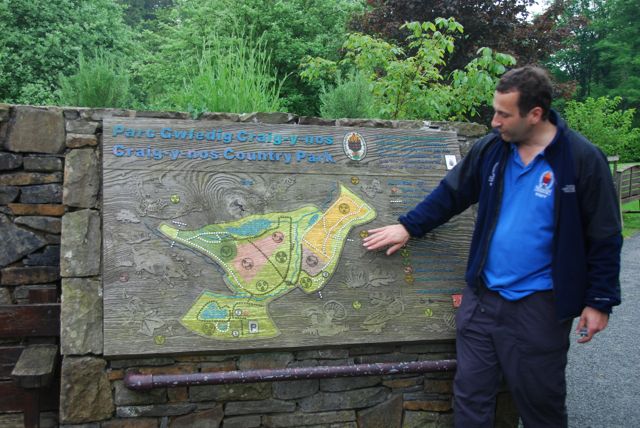
It is always good to pencil test a trail or path through a site from the view of a guest.

Planning by wandering around also means field-testing your ideas by walking through your plans before you put them on the ground. If you are working on something where the infrastructure has not yet been built, this may mean that you have to pencil-test your ideas by literally taking a pencil to your floor plan or site plan and then trace the proposed steps of staff and visitors using a variety of perspectives. Doing this will help you identify and correct potential bottlenecks, glare issues, and other problems (why did the architect propose keeping food for the live exhibits in a room on the other side of the building from the animals?) before they are built.

So whenever you are out, pay attention. Wandering around can be one of your best planning tools. And it’s a heck of a lot of fun.

Lisa Brochu

* J.R.R. Tolkien’s The Hobbit

Five Reasons Why You Should Have an Interpretive Plan

I cringe when I hear the words Ready-Fire-Aim used to describe the planning approach that many organizations use in developing new programs and facilities. I cringe because it was my favorite approach thirty years ago. I simply had no planning experience and it seemed reasonable to try something, anything, and hope it would work. Funders and managers

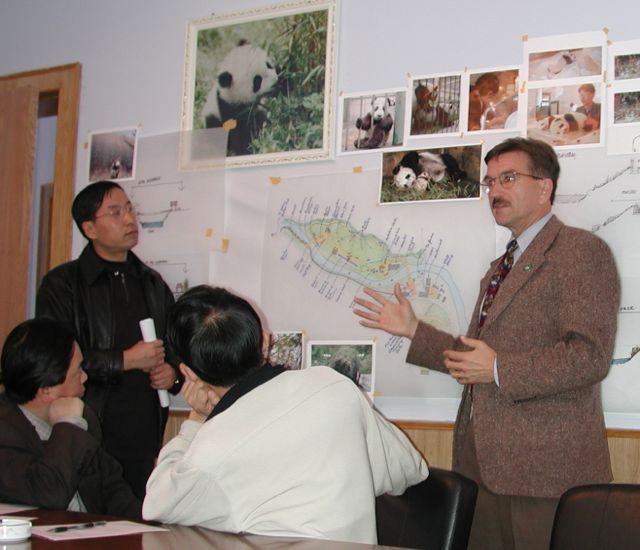
Lisa Brochu directed the interpretive plan in 2001 at Wolong Panda Reserve in China. Walking the route visitors will take helps in analysis of site mechanics.
Lisa Brochu directed the interpretive planning process in 2001 at Wolong Panda Reserve in China. Walking the route visitors will take helps in analysis of site mechanics.

sometimes enable this process by providing money for an idea without a plan because it just sounds like something that might fly or because an ego drives the process, causing you to build a new facility, exhibit, or program because the boss or a donor wants it.

Most companies, organizations and agencies have a stated mission. They know their purpose, but then they guess about what will work to help them achieve that mission because guessing is faster, cheaper, and easier than participating in a thoughtful process. Here are five reasons to slow down and invest in a plan.

  1. Save money – You won’t waste money on useless facilities or programs. It is easy to build a theater that rarely has an audience, an exhibit that doesn’t get seen, a building that has no traffic, or a tour that never quite has enough people to break even. With a good plan you save more than the costs of planning by not building things you don’t need. You also don’t spend money forever maintaining facilities or programs that underperform.
  2. Enhance quality – The very best experiences are designed with specific customers in mind to achieve objectives and work seamlessly making thoughtful use of available resources. That rarely happens by accident.
  3. Builds consensus – Great plans involve diverse stakeholders and build an understanding of what is being planned. It’s a team-building process. Top-down orders that don’t consider the needs of staff, customers and partners often result in projects that fail due to lack of support from those who must implement them.
  4. Everything sends a message – Often an architect or engineering firm is hired for the specific purpose of building facilities. After the infrastructure is on the ground and it’s difficult to make changes without great expense, they invite an interpretive planner to determine what to put in or around the facility to create amazing experiences that engage people and help them understand complex processes, people and places. But in so doing, they’ve sold the experience short – the building, landscaping, flow of traffic, site, elevations, aspects, mechanical systems, lighting, textures, colors and more can help tell a story and encourage engagement. If the architects or engineers don’t understand the story and objectives in telling it, they can inadvertently create conflicts with the desired impact of the interpretive experience. Form should follow function in these facilities, and that requires thoughtful planning right from the start with a full understanding of the interpretive implications.
  5. Well-planned facilities/programs get better as they age. They get fine-tuned, improved, morphed toward a planned future. Ill-conceived projects are abandoned, retrofitted to new uses and continually modified to work in a minimally acceptable way.
The Wolong Interpretive plan involved managers, scientists and local citizens.

A thoughtful interpretive planning process will bring people together around the mission and vision of the organization and objectives of the project and/or program. There are no doubt many other reasons for starting your project with a well-reasoned interpretive plan, but if you need help convincing yourself, your boss, or your donors, the five listed here should give you a place to start that conversation.

-Tim Merriman

Who’s really in charge – power, authority, or influence?

Think of the last time you had a dinner party. Perhaps your spouse invited the boss and his family and now you’re faced with figuring out the menu. You ask your spouse what to serve, and he or she says, “It doesn’t matter, you decide and I’ll be fine with that.” Okay, you’ve been given authority. So you make a decision to have steaks cooked on the grill and you’re about to head to the market to buy the meat when your spouse says, ever so gently, “You know, the boss is a vegetarian.” Your authority to make a decision has gone right out the window. Your spouse’s boss has power to call the shots even without being party to the discussion, simply by virtue of being the keeper of your spouse’s job. And so, based on your spouse’s influence, you opt for a vegetable lasagna and green salad instead. You could, in fact, put your foot down and say, “We’re having steaks – it’s too hot to turn on the oven,” but you know that even though you have the right to make that call, it’s not in your best interest to do so. And so is born the power-authority-influence conundrum – who’s really in charge?

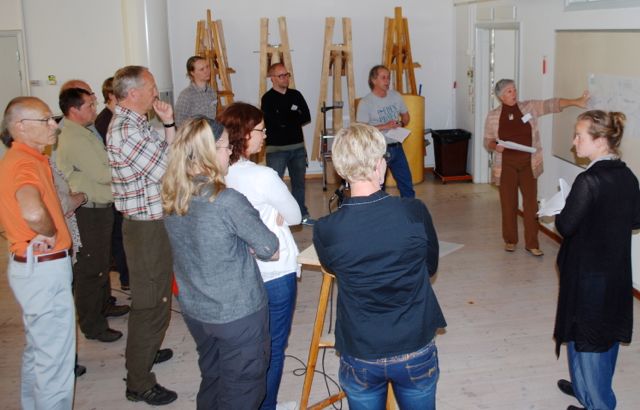
When planning, it is important to have the right people involved. (planning presentation in Sweden in this photo).
When planning, it is important to have the right people involved. (LIsa leading a planning presentation in Sweden in this photo).

It doesn’t matter whether you’re talking about a small committee meeting to plan a single special event at your workplace or getting stakeholders together to discuss a multimillion dollar community development project, the dynamics required to achieve success depend in large part on who does or doesn’t come to the table to take part in the discussion. A good facilitator will try to assess who holds the power, authority, and influence in the group that he or she is facilitating, but without the right people at the table, it may be difficult to facilitate the group to a successful conclusion. I’m measuring success, of course, by the ability to achieve the objectives set forth by the group.

Power, authority, and influence are very different things and although some individuals or entities that make up your planning group may fall into more than one category, chances are good that most will land squarely in one and only one. Over the life of any project or meeting, players may even shift from one category to another depending on the specific issue on the table at the time.

Skillful facilitation requires recognition of who falls into what category and then using that knowledge to help achieve the objectives of the group overall.

Authority gives someone the ability to sign off on and take responsibility for various decisions. This person might seem to be the most important player at the table because he or she has the right to make decisions, but that’s rarely the case in actual practice. The person with real power may be the one who holds the pursestrings or some other valuable resource, without which the project cannot be completed. Unfortunately, sometimes that person or entity realizes the strength of their position and uses it as a bludgeon to get their way, in effect holding the authority figure hostage so that he or she must make the decision the power figure desires, regardless of whether it is good business to do so. But that’s where influence comes in. Influence might be exerted by a single individual (for example, the person who was the founding father of a program or place, which causes people to listen and consider what he has to say before making a decision). Or it might be exerted by a stakeholder group such as consumers, supporters, or friends. In either case, influence may sway the course of a decision depending on how persuasive the argument becomes.

Ideally, these three individuals or entities will work together to arrive at consensus or general agreement about how to proceed in any given situation. A good facilitator can help that happen, but if one or more of the three groups (or individuals within those groups) simply refuses to participate or cooperate, be prepared for a project to stall or end without achieving its objectives.  To avoid that situation, think ahead about the individuals or groups that should be invited to meetings and at what time in the process to create the most desirable discussion and decision-making environments. Crafting the right team and keeping all members of that team engaged at critical points along the way is vital to success.

Lisa Brochu

Facilitators – the Question People

We have just returned from an excellent Interpret Europe Conference in Sigtuna, Sweden, with about 165 colleagues from 40 nations. I am mulling over the ideas than ran through the presentations. “Be a facilitator,” certainly seemed to be one of the consistent messages. Excellent keynotes by Ted Cable, Mette Knudsen, Poul Seidler and James Carter were especially thought provoking.

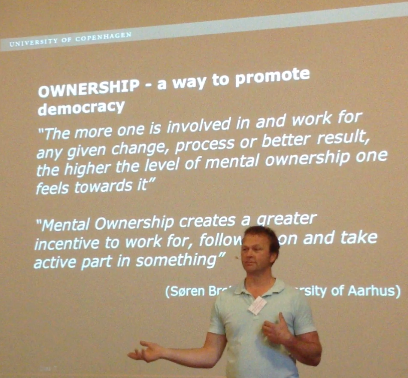
Poul Seidler spoke about our audience taking ownership if we facilitate well.
Poul Seidler from Denmark spoke about our audience taking ownership if we facilitate well.

I think of the many titles under which interpreters work – naturalist (expert), historian (expert), presenter (communicator), ranger (problem solver), guide (expert communicator), visitor information specialist (expert) and program specialist (communicator). In most cases we are doing the same kinds of work but the title makes us sound tilted one direction or another. Most organizations seem to value titles that set us up as content experts, information specialists and people with answers. And yet we know that good interpretation is much more than giving information.

Despite the titles, we might well be ahead to think of ourselves as “the question people,” not “the answer people.” Mette and Poul emphasized the value of an interpreter being not in front of or beside those with whom we work, but behind them. We facilitate experiences by helping others understand the world and stories through our questions. “What do you find here of value? What do you see? How would you like to explore this place? What should we do here?”

Sam Ham gave a great presentation at the Nordic-Baltic Seminar at the Swedish Centre for Nature Interpretation just before the Interpret Europe Conference. He described the transitions in the field from didactic approaches, being experts giving information, to being entertaining presenters with no other purpose than to keep people engaged, to being true interpreters, facilitating self-discovery of the visitors’ own thoughts and meanings about a place or story. Research suggests that effective interpretation gets people to think more deeply, having internal conversations and discussions with others about what we encounter. When interpreters simply tell visitors what they are seeing, the visitors may or may not really be thinking about the subject. Interpreters who ask a question that invites visitors to explore, think, process and remember engage their visitors’ minds. Few people are given the title “facilitator,” but facilitation is what helps others find answers for themselves that endure, enlighten and grow.

Sam Ham gave a very inspirational keynote at the seminar at the Swedish Centre for Nature Interpretation.
Sam Ham urged us to inspire people to think and have conversations during the seminar at the Swedish Centre for Nature Interpretation.

Dictionaries suggest that “to facilitate” is to “make easier,” but interpretation’s aim is not necessarily to make things easier, for the interpreter or the visitor. Perhaps interpreters even make experiences with nature and culture more challenging, to understand, to plunge into the depths of our minds with new ideas, unanswered questions and the desire to learn through exploration. Simply naming things and being experts is certainly easier than thinking about the use of powerful themes, asking questions that provoke people to think and planning experiences that create lasting engagement.  But facilitation of heritage experiences is likely better for everyone when the interpreter chooses not to be just an expert. The challenge is to ask the right questions and place people in situations where they will start conversations with themselves and each other.

Lisa and I want to thank the keynoters named above and Patrick and Bettina Lehnes of Interpret Europe for facilitating a thoughtful conference with friends and colleagues from all over the world. The entire group challenged us to think more about heritage interpretation, always a good thing to do.

– Tim Merriman

On the Road in Stockholm – The Music and Theater Museum

Entry door to the Musik/Teater Museet.

We are on the road again in Stockholm, Sweden, on our way to the Interpret Europe Conference in Sigtuna and the Nordic-Baltic Seminar on Heritage Interpretation and Cooperation in Uppsala. We were here eighteen months ago for a conference in Visby on Gotland Island and enjoyed wandering around Stockholm for a couple of days at Christmas time when the winter decorations and celebrations add a festive atmosphere. On both of our visits here, we’ve stayed in Ostermalm in the heart of the city and enjoyed the food of the 1895 Saluhall markets and cafes of Gamlastan, their old town.

We kept walking near the Musik/Teater Museet on both visits and this time we stopped by to see how it compares with other music museums we’ve seen around the world. The entry fee is 70 Swedish Kronors (SEK) each (about ten dollars) and we really didn’t know what to expect from the signage outside. It’s in a very old and beautiful building but the entry is understated and somewhat difficult to find.

We started with the interactive musical instruments in the hall of music history. This was not the grand display of every lute ever collected or elaborate labels about the origins of each drum. The museum has many of the instruments mounted and ready to play (even in tune – wow) and you are invited to try them, creating a delightful cacophony with other museum goers. Signage is in Swedish for the most part, but since so much of the exhibitry revolves around sounds rather than words, we rarely referred to the English translation provided in a carry-around notebook. Some of the exhibits have videos or recordings behind them with earphones or audio wands to avoid an overload of repetitive

Lisa tried the harp and liked it a lot.

soundtracks. Lisa and I both enjoyed playing a variety of drums, especially with the complete trapset which allows you to play backup to ABBA, the famous Swedish group of the 70s. Lisa also tried the harp and swears this could be her future career. A Karaoke room invites you to become a lead singer with ABBA and other musical groups.

The museum also includes a couple of galleries devoted to theatre and the marionettes exhibit was fun to see. I had a puppet theater in the 1970s and 1980s in my work with state parks and a nature center, and had pointedly avoided marionettes because they are more challenging to make. The ones on display were beautifully crafted by varied cultures. Ipads mounted in tables and a couple of staged areas highlight the marionettes in performance.

The museum building itself seems positively medieval, which adds to the ambiance as you tread on creaky wooden floors and move from gallery to gallery via substantial stone staircases. The current photo exhibition in one wing features the

The gift shop is thematic and shares instruments from varied cultures at reasonable prices. The cards, posters and other artwork are all about music and theater.

The drums are from Africa but you are invited to play them.

We enjoyed the museum a great deal, largely because of the friendly greeting we received and the encouragement to interact with the instruments. If you have the chance to visit, don’t miss the Saluhall just a few blocks away to enjoy the tradition of fika – time for a great cup of coffee and a baked treat with friends or family.

– Tim Merriman

Ecotour to National Parks of Rwanda – Gorillas and Duikers and Chimps, oh my!

When we first read Gorillas in the Mist by Dian Fosse and then saw the movie, we were intrigued by the possibility of one day visiting the Virunga Volcanoes to spend time with mountain gorillas. It seemed a distant dream until October of 2012 when we were training guides in Rwanda’s Nyungwe National Park. On our days off, we took a short side trip north to

 Mountain gorillas are the attraction in Volcanoes National Park in northern Rwanda.
Mountain gorillas are the attraction in Volcanoes National Park in northern Rwanda.

Musanze and had an unforgettable experience with mountain gorillas. We felt privileged to spend time with the gentle giants of the Kwitonda group, one of ten gorilla families visited each day by tourists. Visitors are asked to stay seven meters (21 feet) distant from them, but the gorillas don’t seem to know the rules. Occasionally, they approach out of curiosity or just to get somewhere they need to go and it is breathtaking, but not at all scary.

Rwanda has three great national parks that differ in a variety of ways.  From January 22 to 30, 2014, we will lead an ecotour taking a small group of ten people through these amazing parks, including chimp tracking and a visit with the Fosse’s beloved mountain gorillas. You can join us on this amazing adventure.

Nyungwe National Park in southwest Rwanda gives us a chance to track chimpanzees through one of Africa’s largest and most pristine rainforests at the famed headwaters of the Nile River. Surrounded by tea estate communities, we will enjoy meeting local people and sharing their cultural traditions of dance, songs and stories. Skilled guides will take us through forests dripping with orchids in the hopes of spotting some of the 268

Chimp tracking in Nyungwe is a rewarding hike in rainforest.

species of birds including 26 endemics (species found only there). Nyungwe is also one of the best primate parks on the planet with 13 species, including chimps, Angolan colobus, red-tailed monkeys, mountain monkeys, blue monkeys, olive baboons, and many more. We saw eight of the 13 species in our brief visits there in 2012 and early 2013.

After Nyungwe, we travel on to the famous Virunga Volcanoes and spend an unforgettable morning with mountain gorillas. Skilled trackers stay with them 24/7 both to protect them and to know where they sleep at night. Following our guides’ and trackers’ advice and supervision, we’ll take a hike into the bamboo forest to spend an hour up close and personal with these giant vegetarians. Permits to see the mountain gorillas are not cheap, but mountain gorillas simply would be gone if park managers were not expending such great effort in protecting them from poachers and habitat destruction. Your permit fees are an investment in the conservation of one of man’s closest relatives in the animal kingdom. The tourism program started by Amy Vedder and Bill Webber over twenty years ago has provided consistent protection for the mountain gorillas in Rwanda, allowing this population to triple in size from a low of just over 200 to over 770. That’s still a very small population, but you will be one of the fortunate few people in the world who have had a chance to see them behaving normally and naturally in their own habitat. The habituated gorillas have learned to ignore the humans that take their photos for an hour every day.

Topi are one of the many beautiful savannah animals in Akagera National Park.

Our last park on the itinerary is Akagera National Park on the northeast border of Rwanda near Serengeti National Park in Tanzania. Akagera’s combination of savannah and wetlands provide habitat for an astounding variety of birds and big animals. Here you can find the more traditional African safari animals – elephant, black rhinos, giraffe, cape buffalo, impala, zebra, wildebeest and more. The birding is world class with more than 500 species of birds. As of this writing, leopards are the only cats found in Akagera, but park management has plans to reintroduce lions and cheetahs in the near future. The wetlands are beautiful and teeming with wildlife including hippos and crocodiles.

We will stay in four and five star bush resorts in Nyungwe, Volcanoes and Akagera, some of the best in the world. The food is wonderful, the people are delightful and the cultural stories are unforgettable. We travel with Safari Legacy, one of the most experienced safari providers in east Africa, but this trip is absolutely unique, designed to give participants a once in a lifetime experience in one of Africa’s smallest but most biodiverse nations.

Ruzizi Tent Camp in Akagera National Park is an amazing bush resort with hippos just in front of your very comfortable tent/room.

People who travel with us often say they go looking for the wildlife experience, but leave with a deep connection to the place and the people. For us, Rwanda has the potential to make that incredible connection. The nation has a unique history and has held on to some of the most beautiful natural places and unique species in Africa.

The trip begins and ends in Kigali, Rwanda’s capital city. The Genocide Memorial Centre in Kigali, which we will visit, is a museum of immense power, telling the story of the events leading up to and sparking the genocide thoughtfully and with great compassion. People heal after tragedies but telling the story and remembering in order to avoid similar difficulties in the future is part of the healing. Like the Anne Frank House in Amsterdam, this museum leaves its visitors with an appreciation of the power of the human spirit to recover and work through heartache.

As always, we will provide plenty of opportunities for souvenir shopping and time for relaxation. Anyone can opt out of any activities that are uncomfortable at any time, enjoying some down time at our accommodations instead. Please note that the minimum age is 15 for most hiking activities requiring permits. This tour will involve moderate hiking and physical exertion at elevations ranging from 5000 to 9000 feet (1700 to 3000 meters), but is suitable for most people in reasonably good physical shape.

Blacksmith plovers are common in the wetlands area at Akagera.

You can download a PDF file of the complete RWANDA NATIONAL PARKS ECOTOUR ITINERARY. The base cost of the tour is $4,750 and does not include the round-trip plane flight to Kigali, tips for guides or soft drinks and alcoholic beverages purchased along the way. All other ground travel, food costs and parks fees, including permits for chimpanzee and gorilla trekking are included in the tour price. We have very few seats left so please register right away if you wish to go. It’s important that we get gorilla permits purchased well in advance since the number of visitors each day is severely limited.

Please call us at 970-231-0537 if you have any questions at all or are concerned over the physical requirements for this trip. We have trained all of the guides at Nyungwe National Park and know them to be among some of the best in the world. We look forward to sharing these unique places with you while traveling with a very congenial group to enjoy spectacular scenery, communities and wildlife.

– Tim Merriman and Lisa Brochu